Tuesday, September 30, 2008

karyn blog #2: Through the Lens of Time

Through the Lens of Time: Images of African Americans from the Cook Collection of Photographs

Reverend John Jasper Virginia Beach-Fishermen Crinion Corner of 7th and Cary Street

This collection is composed of photographs taken by George and Huestis Cook. Huestis was one of the first Southerners to photograph African Americans in a realistic or natural setting. Some of the photographs are staged, while others are completely spontaneous.

Collection Principle

Two Williamsburg authors, Alfred Kocher and Lawrence Dearstyne, were referred to Huestis Cook for illustratiions of their nineteenth century book. They discovered numerous negatives and prints in his attic and put together the Southern Exposures Exhibition in 1952 at the Virginia Museum of Fine Arts. In 1954, 156 of the photographs were printed in a book called Shadows of Silver. The Valentine Richmond History Center bought the collection from Cook’s widow in the 1950s. This collection of 291 images represents the “under-documented” community of African Americans in Central Virginia from the late eighteen hundreds through the early nineteen hundreds. This collection introduces an overlooked, yet very important link in the Virginia population. This is a joint project between VCU Libraries and the Valentine Richmond History Center.

There are no restrictions to the images in this collection. According to Virginia Commonwealth University, the images may be printed, reproduced, and used for non-commercial, personal, or educational purposes.

Object Characteristics

To view the images, you can either browse the collection and select individual photographs, or you may view the collection slideshow. The individual images are thumbnails listed numerically, then alphabetically with 20 per page. Each image has 3 categories: title, handwritten notes, if any, and subject or what the image is about. Clicking on the thumbnail provides a closer view, which is a JPEG. Zooming is not an option. However, you are given the option of adding images to a list of favorites. Also, VCU provides information for ordering copies of the photographs.

In RealPlayer, the slideshow displays 10 images, while a voice-over talks about the collection.

Metadata

Each enlarged image has these details attached to it: title, photographer, date, location, subject, contributors, negative number, negative type, image size (in inches), type, format, ordering information, and collection. The photographs with handwritten notes have that field in the metadata also.

Intended Audience

The intended audience for this collection is everyone from historical researchers to school children. VCU and the Valentine Richmond History Center want people to access and gain knowledge from this collection.

All the information, aside from the images, is on the same page. This almost guarantees that you cannot get lost or confused while browsing. The VCU Digital Libraries Collections use contentDM which allows the user to adjust their preferences. This was a great idea until I changed a few settings. Either the images did not show up on the page or the page still looked the same. Other than that, this small, simple collection was very well put together.

Cschley Blog 4: Smithsonian, American Discovery Galaxy, Zoos: A Historical Perspective


Collection Principles. Zoos: A Historical Perspective is a digital collection of excerpts from pamphlets and guide books published by zoos over the past century that have been collected by the National Zoological Park branch of the Smithsonian Institution Libraries. The collection is an online sample of those publications, including maps, drawings and photographs of zoos from over 30 states and 40 countries, which illustrate the variety of roles that zoos have played and the many facets of their operation and promotion. As noted in the introductory text by the institution’s National Vertebrate Librarian, the guides to wildlife conservation parks and descriptions of early animal collecting expeditions by zoo curators give some insight to the roots of modern animal study. Some of the photographs of animal enclosures, restraint devices and mock theatrics may be unsettling to some, but are nevertheless an important part of the history of human-animal relations. The promotional nature of the items in this collection also demonstrates the history of graphic design, illustration and advertising used by public and private institutions throughout the years.
Many of the items in this collection were collected by former National Zoo directors and staff or accumulated over the years as zoos routinely mailed their publications to and among one another. Those materials were filed and maintained for many years by former National Zoological Park librarian, Kay Kenyon. Because annual reports were retained for each year, the collection grew enormously. A consolidation of the files resulted in the October 2002 online exhibit presented here.

Object Characteristics. Thumbnail images drawn from the pamphlets and guidebooks include photographs, drawings, paintings, and maps in jpeg format, largely in black and white grayscale, with a few dull color photographs. The thumbnails are 200 x 125 pixels with click–to-enlarge to full-scale images at 483 x 359 pixels.

Metadata. The choices in the main menu provide links to an Introduction, Explore the Collection, National Zoological Park Library, and the SIL Digital Library, of which this digital collection is a part. The Introduction section presents additional resources for "Zoos: a Historical Perspective" with a link to an internet site for historical zoo images from the Library of Congress' American Memory Web site, as well as a list of related books and articles, with a link to the most recent article from 2002. The collection is presented in a country-by-country listing in alpha order, with varying types of associated metadata, including the apparent name of a pamphlet and author, if any, for the pamphlet or guidebook, with a title for the image, but in many cases, very little additional information to indicate the origin of the image itself, whether a photo or painting or drawing, except, in the case of the US ones, to note the annual report from which the image is drawn. Dates are provided only occasionally.

Intended Audience. The introduction indicates that the collection is intended to highlight the value of this digital pamphlet and guidebook resource for both zoo and cultural historians. The collection could also be of interest and use for the student (high school and college) interested in researching the history of zoos, early animal conservation parks or animal collecting expeditions. Graphics artists, or at least those who study the history of graphic design for zoos or other public institutions, may have an interest in the images and graphics presented.


Tami Blog 4: African Vision: The Walt Disney-Tishman African Art Collection


African Vision: The Walt Disney-Tishman African Art Collection

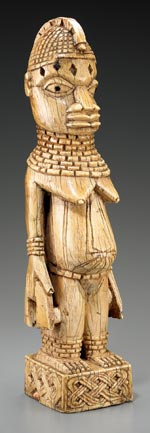
African Vision: The Walt Disney-Tishman African Art Collection is an exhibit that recently showed at the Smithsonian’s National Museum of African Art from February 15, 2007 to September 7, 2008. The Tishmans began collecting African art in 1959 and over the next 20 years built one of the greatest private collections in existence. The Walt Disney Company bought the collection in 1994 with the intent to permanently house the exhibit at Epcot Center. Although it was never publicly display while at Walt Disney, the collection was made available for exhibition loans and publications both in the US and in Europe. Then, in 2005 Walt Disney World Company gave the 525-piece collection to the Smithsonian’s National Museum of African Art.

Collection Principles

This exhibit displays 88 objects from the Tishman collection. It is divided into five sections – “Follow the Art,” “Masks,” “Ideal Figures,” “Power & Prestige,” and “Explore African Art.” These sections can be reached by clicking on a drop-down menu at the top right of the page. There was no indication of why these particular pieces were chosen or any explanation of the chosen titles for each section. For example, in the “Masks” section, is this every mask in the collection or just certain pieces? Also, there are figures exhibited in the “Power & Prestige” section. What makes them different from the figures shown in the “Ideal Figures” section? The section entitled "Follow the Art" is essentially a timeline of important events concerning African art.

Object Characteristics

Perhaps the decision to not place any informational data on the section page was a conscious one, as the result is a very powerful visual of a large photo of a piece of African art when you click on a section. Additional pieces of each collection are exhibited in thumbnails to the left of the large photo. Once you click on a piece of art, that piece is then shown in a large jpeg in the middle of the page. Each piece has at least one accompanying jpeg that shows greater details of the object. None of the photos can be zoomed.

Metadata

The metadata in this exhibit is very good. Accompanying each piece is information listing the African people from which the piece came, when it was created, its composition, size, unique number, and catalog number. In addition, each jpeg has the name of the object and the number of viewable photos available embedded in the frame of the photo. You can also click on More/Less Information and find out what the object is and how it was used. There is no discernable way to search the collection.

Intended Audience

This is a beautiful collection that would be of interest, not only to connoisseurs of sculpture, African art, or ethnic art, but also to the general public as it generated interest in the in-house exhibit. In addition, the last section of the exhibit (“Explore African Art”) includes a pdf document of fun games, such as word searches, puzzles, and Q&A’s, that could be utilized by teachers and their students. This site would also be useful to researchers studying African peoples and their art and customs.

Monday, September 29, 2008

Geoff Willard Blog #5: Coney Island History Project

This "award-winning website" features all things related to the playground of the world, Coney Island, focusing particularly on oral histories, photographs, and ephemera. The digital asset management management back-end of the site is the open source OpenCollection.  

Collection Principles
Along with the run-of-the mill statement of purpose ("our mission is to record, archive and share oral history interviews; provide access to historical artifacts and documentary material through educational exhibits, events and a website, etc."), the Coney Island Project also "teaches young people the techniques of oral history" and serves as something of a community organizer. I assume that the project focuses only on the playground, and not the general neighborhood, based on the collection materials.

While the descriptive image metadata is moderately deep (as one might expect for a DAM system), the oral histories are not transcribed and the images are displayed using Flash. Audio playback (also Flash) does not feature a volume control, nor is it easy to scrub, both of which are personal pet peeves. 

Object Characteristics
All of the audio is streamed, although this could be a rights issue. Unfortunately there is no rights information attached to the object from a user's perspective, so were I to capture the audio with a stream ripper, I have no idea if I can repost it on my own site. 

The photo-zooming that they're employing with OpenCollection seems quite cool - not quite Luna Imaging cool, but better than most of the other digital collections I've looked it. You can zoom from 1% - 600% on an image, but anything over 100% becomes increasingly pixelated. There's an option for labels (maybe something like the labels on a Flickr image?), though none of the images appear to have them. Every photo has a unique ID number. I am admittedly too lazy/cheap to download a program to suck up Flash images, so any further structural components are a mystery to me. 

Metadata 
I can't comment on whether they're using controlled vocabularies, but their descriptive & structural metadata is quite good. Most photographs and ephemera have thorough descriptions, description sources (marked with a code), hierarchical relationship data, physical dimensions, creation date, and the aforementioned ID number. Oral interviews are noticeably briefer, only listing the interviewer, interviewee, location, and a brief description of the interviewee's relationship to Coney Island. 

Intended Audience
Coney Island enthusiasts or information seekers should flip over this collection, as well as general amusement park enthusiasts/historians (there must be amusement park historians, right?). Fans of the movie The Warriors might dig it too...

Sarah Weinblatt Blog 4: The Fitzwilliam Museum: French Impressionists


The Fitzwilliam Museum is located in the United Kingdom. The foundation of the collection is from a the collection of Richard, VII Viscount Fitzwilliam of Merrion who, in 1816, left his art works and library to the University of Cambridge. He also left funds to build an institution to house his collections. The Impressionist paintings at the Fitzwilliam have mainly been acquired through gift and bequest. The first paintings entered the museum when a man named Frank Hindley Smith gifted 30 paintings and drawings. The French Impressionists online exhibition is one of many found on their website.

Collection Principles


According to The Fitzwilliam Museum website, the foundation of this online exhibition is a selection of works by French Impressionist painters. The entire collection at the museum consists of more than one hundred paintings, drawings, prints and sculptures. The online exhibition contains forty highlights from the collection such as works from Seurat and Cézanne.

There is no explanation as to why these forty objects were selected for this exhibition. The site only states that these are the highlights from the collection.

A history behind the Impressionist collection is available as well.

Metadata

The metadata that is available for each of the forty paintings in this online exhibition includes:
  • Title of painting
  • Painter
  • Year(s)
  • Medium
  • Dimensions
There is also information regarding how the painting was acquired into the collection.

Catalogue records are available for these paintings which include: Title, Maker, Category, School/Style, Technicque, Dimensions/Description, Date, Provenance, Inscriptions, Marks, Documentation and Accession Number.

A description of each of the paintings is included like a label that would be found in a museum setting. These descriptions include a brief history about the painting.


Object Characteristics

The scanned images of the paintings are jpg files. One is able to access a larger version of the painting by clicking on the object which then directs you to a new window. However, this new window does not allow you to zoom in or out on the object.

In order to access the collection, the viewer must click on the link "Artist's Gallery." From there one can click on links that separate the paintings by painter. For example, to view paintings by Pissarro you would click on his name. The result would be 4 images with the title and painter's name listed below the image. Once you click on the image you are taken to a page that has the metadata previously discussed along with a image that you can enlarge by clicking on it.

You can also click on the link to the catalogue record. I found the catalog records very interesting because of the listing of the provenance of the painting. This is not often seen in online exhibitions and is rarely provided on a museum label but is very important information. I also liked the inclusion of any stampings or markings on the paintings because these are often hard to decipher from an online image especially when one cannot zoom in on the object.

Intended Audience

The intended audience for this online exhibition is anyone interested in the French Impressionists. A brief introduction to who the Impressionists were is included on the site for those visiting not familiar with the Impressionist movement.

Overall, I found this online exhibit very easy to navigate and very user friendly. I liked that the catalogue record was included for the extra information regarding provenance and markings as well.

Sunday, September 28, 2008

Jonny Grass Blog 3, California Digital Newspaper Collection


The California Newspaper Digital Collection is a digital collection of newspapers from California from 1849-1911.  It is housed at the Center for Bibliographical Studies and Research (CBSR) at UC Riverside and is a part of the National Digital Newspaper Project (NDNP).  NDNP is a “joint venture of the National Endowment for the Humanities and the Library of Congress to create a national digital newspaper resource representing papers from all states published between 1836-1922.”


Collection Principles:

The CNDC aims to digitize and catalog California newspapers from 1836-1922, so these are the broadest geographic and temporal parameters of the collection objectives.  This time period has been divided into manageable chunks, each of which will be funded by a grant.  The first grant covered newspapers published from 1900-1910, while the second grant targets 1880-1910.  The project is intended to be completed over 20 years and include one million digital pages; the CNDC has received grants for 2005-2009 and plans to apply for further funding.  Based on the funding of past grants, the project has digitized issues of the Alta California, the San Francisco Call, the Amador Ledger, the Imperial Valley Press, and the Los Angeles Herald.  It is not explicitly stated why these newspapers were selected first, but the project, which began with the Alta California as a test case, has emphasized preservation as a primary objective from the start, with searchability and research access as other goals.  The CNDC site directed me to the site of the National Digital Newspaper Program (NDNP), the parent project, for more information.  This page explained where each state’s project searched for its materials, stating that the project inventories holdings in public libraries, county courthouses, newspaper offices, historical museums, college and university libraries, archives, and historical societies.”


Metadata

The collection has its own search engine that enables a keyword search or advanced searches that allow users to set search limits.  When I conducted a keyword search, particular articles were listed along with headline, newspaper, date, and content type.  When I selected an article, the portion of the newspaper featuring that article was displayed; the article was highlighted in gray and the keywords of my search were highlighted in yellow.  A ‘newspaper info’ tab reveals the newspaper, issue date, edition, volume, issue number, and page number.   These records can also be retrieved by using a calendar function —which allows a user to select a date and view all newspapers available from that date —or a browse function —which allows a user to select the newspaper they want and scroll through the dates available.  Technical information includes the site’s creators and their contact information, as well as the resources they used to build the site.  While the source code is available, no technical metadata is easily or conveniently located on the page.


Object Characteristics

The newspapers are presented pan-scans (I believe they are jpegs and were scanned as gifs) as framed images on the page that can be clicked and dragged in order to see a different part of the page.  I could not find an easy way to zoom in or out.  The page can also be viewed as a PDF, which allows the user to highlight, copy, and paste text in a way that is not available with the jpeg.  A text only option is also available, which lists just the text of the particular article the search has yielded.


Intended Audience

The intended audience of the site is the general public, although the research community is clearly a priority.  In addition, the managers of the project clearly intend this project to be an example for other digital collections, as they document the project overview and recommendations for others who intend to implement of similar projects.

Meghan C. Blog 4: Irish Virtual Research Library and Archive Project


The IVRLA project began back in 2005 as a way to educate people on the culture and history of Ireland. It is a five year project that is still going today. The collections are apart of The University College Dublin and consists of 15 different digitized groups, and is still growing. The contents range from manuscripts, photographs, paintings, audio, maps, and other documents that were kept. Many of the pieces are photographs of James Joyce and W.B. Yeats along with other famous Irish peoples, which is very interesting. The project uses the Fedora Commons open source architecture to help distribute their information and create an accessible database for their repository.

Collection Principles
The collection was digitized in order to protect the materials, in many cases, that were beginning to deteriorate with overuse and age. The digitization also began as a way to increase the amount of educational information on the country of Ireland, and through the collections they can make this information that much more accessible to many more people within the communities of Ireland and elsewhere. Some issues I have with this particular collection is that although the initial site that it is contained in is very attractive and easy to navigate, the Fedora Commons level of digitization requires an extra plug-in in order to view the images associated with the project. It is a little alienating for people studying this collection who are working from public computers that are not capable of downloading. It also is preventative due to its extra step, users may stray away if they have little scholarly interest in the materials on the site. On the other hand the images look great!

Object Characteristics
The documents were scanned and made into TIFF files and then later compressed into smaller JPEG files for view on the internet. The TIFF files were made using 24-bit color at 450 dpi. There was a backup made on DVD for each of the TIFF images created. In some cases the documents were scanned twice. When clicking on an image, you can create a border and zoom into the picture that way. It is very accurate and very well done. Once again, the use of the DjVu plugin is a little frustrating, especially since it takes up about 18mb on the hardrive.

Metadata
The metadata is very readable. It is laid out in such a way that general persons could easily identify the information that they are looking for. On the main page for each of the collections they discuss some of the reasoning behind the way they catalogued each image and where it is located in its physical form. The most interesting part of this site is that it claims to be very accepting of tagging being made by individuals, or so the site claims on its background page. There is also a bookmarking function on the site for each image for those doing some research.

Intended Audience
It seems like the audience would be the university community consisting of the faculty and student body, yet it is made explicit that the university is trying to appeal to the community as a whole, to bring Ireland together. It is a very noble project, and there is a generous amount of information contained in the collections that they have digitized. It would be nice to revisit this site in two years to see the progression of the project and to see the impact that it is making on the community.

Jessi Fishman Blog 4: Yale University's Medical Library's Digital Collections


The Cushing/Whitney Medical Library at Yale University's School of Medicine has a number of online digital library collections and they are adding to them continually to expand access to the library's unique collections for scholarly research and life-cycle management of digital objects. The collections are powered by Greenstone digital library software. One of these collections, the Pathology Teaching Collection, contains over 600 digitized images of pre-photography medical drawings that were used to document and explain anatomy and medicine.

Although the collection includes illustrations done by a number of creators, the bulk of the drawings were done by Armin B. Hemberger (1896-1974) who worked at Yale for most of his career and created very scientifically accurate medical images in pen and ink, pencil, gouache, and watercolor.

Collection Principles
For this particular collection, the principles are clearly stated in an extensive "about" section. This section provides a detailed history of medical illustration as a profession in general, and limits the scope of the collection to images created at Yale, focusing on images that were a particularly important resource regarding unusual cases, providing doctors with a rare opportunity to view medical conditions that they would be unlikely to encounter on a regular basis. The library also provides the reasoning behind the digitization of the other collections, including historical artifacts relating to the library's namesakes and a collaboration to electronically publish the full text of Yale medical students' theses. The site gives clear directions on how to use all the search functions, and keeps a permanent background with links to all pertinent sites in the Medical Library realm.


Object Characteristics
Although the actual digitization technique is not stated anywhere completely conspicuously, the images are clear and easy to see, with two options for viewing (one with higher ppi). All the images open in a new tab, which I always approve of, but the title bars for them only have the identifier number, which is not very useful when examining a lot of pictures at a time. The objects are zoomable and they all have associated metadata. Although, as stated, it is not that clear how they did their digitization or how long the images will be accessible for, considering that this is Yale's med school, they probably have a good backing for the collections.

Metadata
The metadata for each object is adequate. The title given to each object is usually taken from the title that the artist gave the drawing in the first place, which helps ensure validity that the object is what it purports to be. However, the "other title" and identifier fields are unclear, and do not provide much assistance to researchers. There is also a rights holder field and a repository field, so the physical locations of the objects can be determined, and a "notes" section which usually involves the medium of the drawing (i.e. pen and paper, watercolor, etc). I would expect that a website from Yale using Greenstone digital library software would associate more metadata with each object, but I suppose the necessary fields are filled in.

Intended Audience
The Pathology Teaching Collection, according to the Cushing/Whitney Medical Library site, is still widely used as a teaching resource in Yale's medical school. The main intended audience, therefore, would be students and researchers at Yale, specifically those looking for detailed illustrations on various pathologies—some related to WWI and WWII chemical warfare. Other intended users would be scholarly researchers focusing on pre-photography medical teachings, detailed medical drawings, or the art of Armin B. Hemberger.
I would also see a wider audience for this type of collection, as the images themselves are vivid and extraordinarily done, and lend themselves in a slightly eerie way to the understanding of the human body, and the digitization is clearly well done as well. In this manner, any number of people might be interested in using this collection, including digitization specialists (or fans) or just people who like sort of creepy old timey drawings.

Saturday, September 27, 2008

Hannah Norton Blog 3: Villanova University Digital Library – Sherman Thackara Collection


This collection contains family papers and personal correspondences of Eleanor (“Ellie”) Mary Sherman Thackara, daughter of Civil War General William Tecumseh Sherman, and Alexander Montgomery (“Mont”) Thackera from 1854 to 1897. It includes, among other information, descriptions of Mont’s service in the Navy in the 1870s, daily life in Eastern Pennsylvania and the Main Line during the latter half of the 19th century, Abraham Lincoln’s funeral procession, and Ellie and Mont’s courtship.

Collection Principles and Organization

The digital collection includes the entirety of the physical collection, including 2115 documents. The Sherman Thackara Collection was donated to Villanova University by Eleanor Sherman Thackara in 1897, and thus represents her decisions regarding what information about her family would be interesting and appropriate to share with the public, rather than any particular collecting policy on the part of the university. The collection is accessible through two points of entry: the digital library search page and a separate finding aid. The digital library page allows for both browsing and searching by keyword, title, author, date, or publisher. The finding aid presents the documents as they are in the physical collection: boxes are arranged thematically, with correspondence grouped by author and recipient, and within folders documents are arranged in chronological order. The finding aid does link directly to the digitized documents.

Object Characteristics


The majority of documents in this collection are handwritten letters of correspondence between various members of the family. Other types of documents include photographs, receipts and business letters, a diary, some books, newspaper clippings, and family documents. Unfortunately, the text of these documents is not searchable – no OCR coding has been done and no separate transcripts are available. This means deciphering handwriting and, in some cases, is further complicated when both sides of the paper were written on and ink bled through from one side to the other. Some zooming capability is available, but it’s rather awkward. As far as I could tell, you could either look at the document filling the screen or zoom in all the way – there is no intermediate level of zoom. For letters, the zoomed in view allows only 2-10 words on the screen at a time, making it even more difficult to read actual texts. All of the images appear to be jpegs.

Metadata

For each document, a separate “details” tab provides metadata including a document identifier, permanent link, date, creator, publisher, subjects, and source. These fields are common across all collections in the Villanova University Digital Library and contain much more complete information in this collection than some of the other collections. Interestingly, the metadata available in the “details” tab refers to a “creator” of each document, while the search tabs looks for an “author” – presumably the term creator is meant to comply with Dublin Core or other standards while the term author is deemed more understandable to the user. Another interesting quirk of the way the metadata is presented is that the document identifier, which includes box/folder/document number and call number for the collection as a whole, is not labeled but simply appears as a header for the rest of the metadata. So it is possible for users to identify a document from the digital collection and find it in the physical collection, but only if they recognize a number like “7/3/18 OM E467.S53” for what it is.

Intended Audience


The intended audience of this collection is presumably the Villanova University community of students, faculty, and staff. For the casually interested user, I think the digital collection contains a lot of interesting information to browse and could be a great hook for users to become aware of the physical collection. As a scholarly resource, however, it falls short, due to the inability for full-text searching and constrained zoom capabilities described above.

Wednesday, September 24, 2008

Lauren A Blog 4: IN Harmony

IN Harmony: Sheet Music from Indiana is an IMLS-funded digitization project hosted by Indiana University and combining materials from the Indiana University Lilly Library, the Indiana State Library, the Indiana State Museum, and the Indiana Historical Society. Though the collection is Indiana-related, it includes important names like Hoagy Carmichael and serves as a snapshot of American popular music during the first half of the 20th century.

Collection Principles
The abstract of the IN Harmony IMLS grant (found on the website under Project Information)
explains that the pieces in the digital collection were selected for digitization based on composer, subject, arranger and publisher. Collection librarians and specialists were then consulted to select additional items based on genre or theme. The collection was created based on the goals of:
- fostering collaborative digital library development by partnering with institutions with complementary collections.
- digitizing a portion of these institutions' collections and making them available to the public free of charge on the web.

- bringing the materials and their metadata together on a single website, to offer federated searching and searching of individual collections.

- testing the hypothesis that approximately 90 percent of copyrights for materials published between 1923 and 1964 have not been renewed.

Object Characteristics

The object scans differ based on their copyright status. Copyrighted items show only a small image of the sheet music’s first page. Underneath is the message "Under copyright protection. Images not available on this site." The user must contact the holding institution to view this material. All other materials have the option of either viewing the sheet music pages online or downloading a PDF. Online, the viewer is allowed to zoom in once. In the downloaded PDF the viewer can zoom in many times, however quality begins to suffer. The PDF is also printable, an important feature for musicians who will probably want to print the sheet music.

Under Project Information there is an entire page on the digitization process, methods of quality control, web derivatives and PDF creation. Here is just a sample:
"All images are created at 400 dpi. All covers as well as all pages with color are scanned at 24-bit color with imbedded Adobe1998RGB color profiles. All other score pages are digitized at 8-bit grayscale with the imbedded profile of Gray Gamma 2.2. The inclusion of the profiles helps ensure that the image will reproduce as accurately as possible.”

Metadata

The collection can be searched by composer’s name, song title, year, instrumentation, genre or subject. The homepage also features thumbnails of featured sheet music for browsing. The featured sheet music seems to have been selected based on illustrations. A few interesting pieces of metadata, included with each item and unique to sheet music, are the instrumentation the first line of the song and the first line of the chorus. These seem like they would be extremely helpful search tools for those of us with poor music memories.

The metadata for each physical object is available alongside the digital image, however the metadata of the digital object is not supplied.
In the Project Information section there is also a page devoted to how the project's metadata was created. User studies were employed and a custom cataloging tool was developed that would meet the needs of the diverse institutions supplying the collection (some focus more on the musical content, some on the arrangement and organization of a collection by its compiler, and some on the cover art). The metadata is mapped to Dublin Core and will soon be made available for OAI harvesting.

One major critique I have is that rights metadata is not given for any of the sheet music. Even for the copyrighted material, which cannot be viewed online, no further information is given aside from a link to the holding institution's website. The name of the holding institution is given in the metadata, along with an "IN Harmony ID" number, but it's unclear if this would be enough information for the institution to quickly find the item. This would again be especially crucial for the copyrighted materials, which cannot be viewed online.


Intended Audience

The project seems like it would largely appeal to music historians and scholars or nostalgic adults. There are no educational activities or lesson plans to help bring teachers or students to the site. Getting these regional collections on the web will expand the audience of each institution by making the sheet music more readily available to the nation and the world and bringing in people already using their sister collections.

karyn j. #1: African American Women Students at the University of Iowa 1910-1960


The African American Women Students at the University of Iowa 1910-1960 is a collection of newspaper articles, photographs, correspondence, oral histories, and other primary sources documenting the experiences of African American women students while attending the University of Iowa. This subcollection is a part of the larger African American Women in Iowa Digital Collection. I chose to write my blog on the subcollection as opposed the collection that it is part of because I found this one to be more interesting and the topic was more specific. It is based on research done by Dr. Richard M. Breaux’s study of African American women students at The University of Iowa and information contributed by several Iowa repositories, namely The Iowa Women’s Archives, The University of Iowa Archives, The State Historical Archives, and The African American Historical Museum and Cultural Center.

Collection Principles

This digital collection was funded by an Institute of Museum and Library Services (IMLS) grant and was created for a fellowship project in digital librarianship by the university’s School of Library and Information Science. It is based on research done by Dr. Richard M. Breaux and several other scholars’ study of African American women students at The University of Iowa and information contributed by several Iowa repositories, namely Iowa Women’s Archives, University of Iowa Archives, State Historical Archives, and the African American Historical Museum and Cultural Center. All of this information can be found on the “About the Collection” page.

There were no impediments to the use of this collection. Everything is accessible to anyone browsing through this collection (assuming you have Audio Player and Adobe).

Object Characteristics

The objects in this collection are listed based on where they fall in the timeline of events. When you click on a year, there is a blurb that tells you what happened in that year. In every blurb, there is a link that sends you to items that are related to the event, person, or group discussed in the blurb. The links in the blurb are basically the same as the thumbnails shown in the section under the blurb called related artifacts. The only difference is that the links in the blurb take you directly to all related artifacts while, clicking on the thumbnail then takes you to all the related artifacts, which are opened in a new tab. Each of the thumbnails can be clicked on to zoom in. You then have the option of zooming in further. All the items are jpegs and the oral histories are opened in audio player.

There is also a section under the blurb that gives you related sources for further information. If you click on the source, it either sends you to the university’s library catalog or the collection where the item can be found.

This collection is very-user friendly and easily navigable, but can be confusing if you are looking for the screen to take you to a new page. Any time you click on an item or want to search, a new tab will appear.

Metadata

The metadata was very well done. There is an abundance of information such as title, original item date, digitized date, topical subject, what digital collection it belongs to, and the collection’s location, just to name a few. Also, many of the metadata fields are linked to more information about the field.

Intended audience

The intended audience of this collection is anyone interested in the experiences of African American women attending the University of Iowa between the years of 1910-1960. Anyone who wants to know more about what happened during those years and in some cases, what happened after they left should check out this collection.

Meghan C. Blog 3: Federal Emergency Relief Administration (FERA) Photographs


(Photograph)

The University of Washington Libraries has digitized this collection of photos from the New Deal era of American history in Seattle, W.A. and the King County area. The photos depict the lives of Americans just trying to make through the rough times of the depression and finding ways to combat the economic situation by doing work within their communities. The collection includes photographs of people working on bridges, schools, park grounds, and other building constructions, as well as people doing general trade work like making furniture and sewing. The FERA collection details an important period in this communities history and gives photographic evidence of how much of the area came to be constructed. The digital collection consists of 274 images that were selected from over 800 different photographs.


Collection Principles
It seems as though the collection was narrowed down due to the situation with the Crossing Organizational Boundaries IMLS Grant. This grant was given to the King County Snapshots digital collection, which encompasses 13 different organizations that helped create the overall collection which the FERA collection is apart of. The images were selected mostly by importance to the collection as a whole and the lack of funding to support digitizing the entire collection.

Object Characteristics
The 274 photographs were scanned at 3000 pixels on an 8 bit grayscale. The images were saved as TIFF's and then later re saved as JPEG files for use on their website. They were re sized to 640 pixels and linked through contentdm. The images are nice, but I feel a little let down by their lack of zoomability. When clicking on an image it brings you to its largest possible view and below that is the title, description and metadata for the scanned image. Yet, I wish there were more. The website does offer some information on the time period from which these photographs were taken, which is very helpful to anyone wishing to do some more extensive research.

Metadata
The metadata seems very inclusive with a lot of links and controlled vocabulary, helping the user better acquaint themselves with the research or images they are looking for. The information included is a little bit redundant, including much of the information that is on the homepage of the site. It is good for those that are unaware of this, but this information is repeated on every single image. It seems slightly unnecessary, but still someone encountering this information through a link would, I'm sure be very appreciative of it. The metadata also contains information on how to attain copies of the images, and a request link which is nice.

Intended Audience
The audience for this particular site and collection would most likely come to it by way of the community, wishing to track down images of their family members or former residences, or the academic body wishing to do research on the vast topics of life during the depression in the King County area. The collection seems as though it is very organized towards the development of awareness towards this time frame and community in general.

Kempleel Blog 3: A Nation of Shopkeepers


A Nation of Shopkeepers: Trade Ephemera from 1654 to the 1860 in the John Johnson Collection of the Bodleian Library at Oxford University is, like many of these projects, mean to accompany or document a physcal exhibition, this one shown in 2001. The exhibit is meant to be a visual chronicle of the mercantile society in great Briatain during the specified time periosd.

Collection Principles:
The objects in the exhibit are all part of a special collection held at the library, the John Johnson Collection, consisting of about 1 million printed "ephemera" or printed material not meant to be kept - advertisements, pamphlets, packing paper, cheap popular entertainments, etc. Dr. Johnson collected in the first half of the 20th century, and the material itself dates from the 16th century until 1939. This particular digital repository, is an on-line copy of a physical exhibit, complete with pictures of the exhibit space and how the materials were physically displayed. Specifically British, the collection is meant to illustrate the merchant state of the British empire. As explicitly stated in the introduction
"The aim in focussing on the ephemera of trade is twofold: to show something of the way in which printed ephemera helps us piece together our social history and to demonstrate how (with the aid of new technology in both cataloging and digitisation) these bibliographically challenging materials can be made more accessible and thus more useful, both to the academic researcher and to the casual web surfer"
In addition to the exhibit, the entirety of the Johnson collection is searchable on the web through a separate catalog page, though that displays only the metadata and not the images.

Object Characteristics:
The exhibit contains 338 individual scans of ephemera, as well as 4 "Supplemental images" and a number of pictures of the physical displays. The pictures are in jpeg format, and are not standardized - some resolutions are vastly higher than others. Clicking on a thumbnail leads to a larger picture of the images, but despite the presence of a zoom button, images cannot be further enlarged. Each object is displayed with a brief essay detailing what the image shows and its probable origins and usage. Supplemental images are tied back to other images in the collection, but are otherwise devoid of description. The collection is navigable as a whole, and is also broken down into different sub-headings by category (shop signs, trade cards, etc.)

Metadata:
All the images are presumable of objects held at the Bodleian Library in Oxford. The objects are titled with their name, trade, trade sign, town (if not London) and date, and are numbered in the order in which they appeared in the physical exhibit, as well as their shelf mark from the collection. As mentioned above the collection catalog is searchable through a sperate web portal, and displays the MARC records, but is in no way linked back to the images.

Intended Audience:
The collection is intended, as stated in the introduction, for both scholars of British history and the casual web browser, who might be interested in the material. It is clearly supposed to promote a somewhat obscure collection and the Bodleian Library, including linking the a store where one can buy a paper copy of the exhibit's catalog (although the link is broken). The exhibit is 7 years old now, and the pages have not been updated, lending the whole enterprise a very out-dated visual style completely different form the library's newer web portal.

Tuesday, September 23, 2008

Geoff Willard Blog #4: Indianapolis Museum of Art


Stumbled upon the IMA in one of our readings for this week. I got a huge kick reading the descriptive tags added by visitors in the sub-section on Contemporary art. Is it weird that I'm more interested in how people are talk about an object than the object itself? 

Collection Principles
The IMA seems to be a "general" art museum in the strictest sense of the word. Their collections span the globe and cut across time, with the only stipulation being that the collected works serve "the creative interests" of the museum's communities. It is unclear why certain pieces were picked as representative samples for their categories, beyond being of that time, region, or style. I'm always frustrated by broad headings such as "Asian art." Can't they drill down just a little bit?

Copyright is explicitly stated for each piece of art. 

Although the IMA allows tagging, they enforce it with a captcha. In my eyes, that's an impediment to use. Like DRM, the people who want to break it will, leaving the casual users struggling to decipher and type words they can barely see. I would encourage more tags, not less, by not using captchas. 

Object Characteristics
The website allows one level of zoom on all of their jpgs, and all of these larger images have an IMA watermark. Dragging and copying a jpg to the desktop reveals the file name, which is a long string of alpha-numeric characters separated by dashes. (It's meaningless to me, but perhaps on their end each chunk of the name subscribes to a naming convention they've developed.) Within the administrative metadata there is a direct link to where the image is stored on the IMA's servers.

Metadata
The descriptive and structural metadata is exceptionally strong, detailing the artist, artist nationality, artist birth-date, creation date, materials, dimensions, credit line, accession number, copyright, the wall label (nice touch!), and my favorite, user tags. At this point I'm not sure how useful the tags are - the tags 'hmmmm' and 'doodle' don't exactly inspire confidence -but that's a problem that can be worked out with scale.   

Intended Audience  
I'm a sucker for most contemporary art, but surely the site also draws visitors in with its Japanese, African, Neo-Impressionist, American Impressionist, and local Indiana art, among other collections. None of the digital collections are particularly extensive though, contrary to their 50,000 physical collection, and maybe that's the point. If the goal is to get bodies through the door (hello $12 tickets!), I can understand the appeal of a handful of teaser exhibits. 

Jessi Fishman Blog 3: Wisconsin Historical Images Cigarette Trading Cards Collection

I found the website for the Cigarette Trade Cards Collection in a rather strange way but I'm glad I did. I searched for "birds" on the Smithsonian Library and Archival Exhibitions on the Web page (because I like birds) and was surprised to see a link to a site about cigarette trade cards (I also like trade cards). So I went to it, and found the very well-designed and full-of-stuff site known as the Wisconsin Historical Images section of the Wisconsin Historical Society. This site has numerous online exhibitions, many of which sound very interesting, but I decided to stick with the trade cards.

Collection Principles
I gathered information about the collection principles behind the Wisconsin Historical Society's Archives right from the "learn about the collections" part of the website..."The Wisconsin Historical Society's Archives collections include approximately three million photographs, negatives, films, cartoons, lithographs, posters, and ephemeral materials from private, business, and governmental sources that document the rich social, economic, and political history of Wisconsin and the upper Midwest... In addition to strong holdings in regional history, the collections have a national focus in the areas of nineteenth century expeditionary photography, Native American images, mass communications, and social action movements, including labor and civil rights." You can really tell from examining this site that the people behind the digitization efforts at the Wisconsin Historical Society are putting a lot of thought into their online exhibitions...the site is clean, aesthetically pleasing, and easy to use, information about permissions and about the opportunity to purchase prints and digital files are readily available, and there are a variety of interesting functions and materials available as well.

Object Characteristics
This is a rather small collection, so all of the objects are listed in alphabetical order, and each has a very lovely thumbnail of the associating image to look at to see if you want to open and learn more about it. Each object is named with a persistent, unique identifier that conforms to the overall naming scheme, and the links to enlarge or buy the image open in a new window for easy viewing. You can also e-mail the image to a friend directly from the object's page. The name and identifying number for each object show up in the title bar of the page to avoid getting lost, and the images are clear, crisp, and beautiful.


Metadata
As to be expected, the accompanying metadata for the objects in this collection is great. There is a large title and description section, followed by the image id, the creator name (if known), the collection name, the genre, and detailed additional information. The search function does not work in individual collections, however, but instead spans the entire online collection, so you usually get more results than you would have hoped for, but still can find what you are looking for and find some other cool stuff along the way. The good metadata records definitely convey that the Wisconsin Historical Society digitization people really know what they're doing and care about the interoperability, access to, and long term management of their materials.

Intended Audience
There are so many interesting collections on the Society's site that the intended audience for the whole thing must be enormous. As for this particular collection, I would say the intended audience could range from serious researchers interested in ephemera from the late 1800s to anyone who happens to like birds and can search in the right places for them. Another intended audience group could be bubblegum (or other trade) card enthusiasts or people interested in the history of advertising.

Emily V - Blog 4 - UT School of Human Ecology Textile Collection Database


While not strictly an exhibition, this online database of a collection made me so crazy that I had to write about it anyway. I am currently taking a course in the Textile Department of Human Ecology, as part of this course we are required to use their collection database. Innocent enough, right? 

Collection Principles
None are indicated, the viewer has no idea what the collection's goals are, how the items came to be given to this department, or any other information besides that given in the object file. Other than a brief blurb on the homepage about the diversity of the collection, we have no idea what is in there unless we search item by item.


Object Characteristics
Aside from generally poor picture quality, no ability to zoom in, and no multi-views of the garments is the problem of accession numbers- there are two of them. An "original accession number" and a regular "accession number" - this baffles me.
Also, amazingly, often when you click on an image you are linked to a different image, with no explanation. (That is when the image isn't broken, which 70% are).


Metadata
Oh my. This is what made me crazy, and this is why I had to write about the database. Not only is information incredibly incomplete (if any is given at all) but, the database is CHANGEABLE BY THE USER!!! By any user- no log in necessary. All fields can be edited, including accession numbers.
 No one knew this until I pointed it out yesterday! I have no idea how long this database has been online, though the phrase "long before I got here" has been thrown around by several people. 


Intended User
Apparently, the students of TXA 355 D, though in the end I had to just walk around through closets of garments looking for my objects. I can honestly not guess at who else might find this database useful.

Note:
The images above are screenshots I took so I could illustrate the problem for the class's TA. 

Katie R: Artists of Brucke, blog 3

Artists of Brucke: Themes in German Expressionist Prints

The Museum of Modern Art created an online exhibition of their German Expressionist prints called Artists of Brucke.

Collection Principles:
This digital exhibit highlights the MoMA's collection of German Expressionist graphic art, organized into themes of Retreat, Christian Motifs, Cabaret, Nudes, and four others. The 120 works displayed in the exhibit are all prints by the main artists of the Brucke, or Bridge, movement in the early 20th Century. Because this exhibit is from the MoMA, has central themes, critical commentary, and extensive credits I would assume that the project was heavily curated and planned in detail.

Object Characteristics:
This exhibit was created in Flash not html, which presents several problems in terms of navigating and viewing the images. New smaller windows are always popping up when the user wants to know about chronology, credits, or a list of the artworks. When the user wants to view an image in detail, a "Return" button is the only way back to the previous page since there is no navigation bar. Users (such a me) might be tempted to close out of the new window, since other information creates a new box. This will close out the whole exhibit. The prints themselves are only presented in Flash, making any copying of the MoMA's images impossible. This seems a little overprotective, since the population who is interested in making a rough woodcut of a naked dancer might be rather small. The website also has a voice-over, as an exhibition guide, that is relatively surprising when he first talks. This audio portion takes time to load, as does the Flash.

Metadata:
The information included with each image is detailed, and includes the basics (title, artist, year, size) as well as the edition number and publisher/printer. Also prominently displayed is the copyright information. All these details make searching interesting, as the curaters have enabled a page of the site to be a visual experience, with thumbnails of all the prints highlighted when certain artists or mediums are chosen. Scrolling over an image annoyingly enlarges it when perhaps you didn't intend to click on that one. The images must be tagged behind the scenes in order to be searched by themes.

Intended Audience:
This site can only be viewed by users at a computer with a Flash plug-in. In order to hear the voice-over information, one cannot be at a public computer without headphones. The images are very nicely digitized, and the information included is brief but concise. This exhibit could excite a student about the artistic movement or be enough to satisfy a websurfer. The MoMA probably uses this exhibit as an example of their commitment to outreach.

Monday, September 22, 2008

Jesse Saunders #3: Somewhere a Voice is Calling

Somewhere a Voice is Calling: American Irish Interpreters, 1850-1975.

This exhibit was curated and posted by the O'Neill Library, one of the libraries at Boston College. The O'Neill Library is focused on primarily on collections related to Government Documents and Media materials. The library hosts a permanent exhibit honoring Thomas P. (Tip) O'Neill Jr., former MA Speaker of the House and BC Alum, as well as temporary exhibits based on materials in the library's collection. The "Somewhere a Voice is Calling: American Irish Musical Interpreters, 1850-1975" exhibit was on display from July-October, 2007. This web exhibit served as an "Online Supplement" to the physical exhibit, of which no other information exists on the library website.

Selection Decisions:
There is no clear information given regarding how selection decisions were made as to what information and materials were included in the online exhibition. Surely the online exhibit was built to work within the context of the physical exhibit in the library, yet with no other information or media (images/video) of what was included, we cannot know how the two worked together and what was pulled from or added to in order to build the online exhibit.


Metadata:
On the pages which contain the photographs and audio clips, there is no metadata given, other than names and song titles. However, on the final "Credits" page, a list of image/photo information, which includes details about those included in the images, when/where they were taken, and who holds the original physical photographs. There are no details given about when/how the scans were done. This page also contains a link to a .pdf document which gives the standard bibliographic citation information for the exhibits audio clips. As with the images, there is no information about when or how the digital transfers were done, yet in the case of the audio there is not even any information on whose copies of the recordings were used for the audio transfers.

Object Characteristics:
Image files are primarily locally hosted .jpg files, with the exception of The Clancy Brothers & Tommy Makem album cover, which is linked to on wikimedia, at http://en.wikipedia.org/wiki/Image:ClancyBrothersFirstHurrah.jpg. Other than that of The Clancy Brothers & Tommy Makem images are quite small, and there are no options to either view or download larger versions. The audio clips are presented in Real Audio format, requiring users to have the Real Player software installed on their computers, and not allowing users to download the clips.

Intended Audience:
As this is listed as an "Online Supplement" to the physical exhibit, the intended audience is clearly people who either already had, or were planning to visit the exhibit. Given the lack of context or further information given about the materials in the physical exhibit, the O'Neill Library has made it difficult for the online exhibit to stand on it's own and provide a full, enriching experience. While it contains some good information, it leaves someone new to the exhibit to go and look for something more on the topic.

Friday, September 19, 2008

Tami Blog 3: November 22, 1963 and Beyond


November 22, 1963 and Beyond

The Lyndon Baines Johnson Presidential Library has an online exhibition showcasing some of the materials in their collection pertaining to the assassination of President John F. Kennedy. The LBJ Library, established in 1971, preserves and maintains for research the papers and memorabilia of President Johnson. However, the library’s holdings also include materials from Johnson’s entire public career, as well as materials related to his family and close associates. The library currently houses 40 million pages of historical documents. In addition, the library actively collects the papers of Johnson’s contemporaries and conducts an oral history program to supplement the written records contained in its collection.

Collection Principles

This exhibit contains photographs, audio transcripts, downloadable audio, copies of note cards prepared for public remarks, a transcript of his speech to Congress, diary excerpts, oral history interviews, and links to complementary or further information on the assassination. The home page of the exhibit is very simple and straightforward. A list is provided linking the user to sub-collections documenting Johnson’s activities on the day of and following the assassination. The extent and depth of information contained in the sub-collections is different for each. For example, the first link, entitled “President Lyndon B. Johnson’s Daily Diary,” takes the user to a short text explaining how the president’s daily diary was created and by whom. It also provides information as to the abbreviations utilized in the diary. Below the text are links to the diary pages. In contrast, the third sub-collection, links to a single photograph.

Object Characteristics

All of the photographs in the collection are JPEGs and, once you’ve clicked on the thumbnail and opened the file, do not have the ability to click on the photo for further enlargement. (However, there are links in the metadata to enlarged TIF files.)The document scans, such as the diary pages, are PNG files and the note card is a GIF file. The note card can be enlarged by, again, clicking on a link to the right of the document. It would be nice to have larger, more detailed examples of the handwritten or hand-corrected documents because these are essentially useless at the size provided.

Metadata

Extremely good metadata is provided for each photograph, such as Image Number, Credit, Image Date, Event, Location, Description, Rights Information, and links to enlarged TIF files. No metadata is provided concerning the audio files, the note card, nor the diary pages.

Intended Audience

Useful for researchers and biographers would be the diary pages containing minute-by-minute evidence of Johnson’s activities directly before and after the assassination. In addition, the links to additional information could be utilized by students and teachers interested in presidential succession and the assassination, as a whole, not just Johnson’s part in it. The photographs, while providing much detail of the event, are more limited in context, pertaining almost wholly to Johnson’s swearing in ceremony, but would be useful to researchers in that regard.

Thursday, September 18, 2008

Claire B. Blog 2: Alcohol, Temperance, & Prohibition at Brown University


The digitized items in the Alcohol, Temperance and Prohibition Collection come from the Alcoholism and Addiction Studies Collection at Brown University. This collection includes over 15,000 items purchased by Charles Bishop, an antiquarian bookseller and researcher of Alcoholics Anonymous and related groups in the United States. These items, ranging from broadsides and sheet music to pamphlets and government publications, built onto Brown’s already large collection of items relating to the history of alcohol in the United States – its use, regulation, and media portrayals of the alcohol industry.

When Brown University acquired this particular collection, it initiated a project to digitize the pamphlets published by various groups leading up to prohibition, during the prohibition era, and ending with the 21st amendment in 1933, which repealed the 18th amendment from 1919 prohibiting the manufacturing, sale or transportation of alcohol.

Collection Principles

The Center for Digital Initiatives at Brown selected these pamphlets in particular because they offered visually-rich, easily accessible scans, represented a manageable segment of an enormous collection, and, importantly, they are all in the public domain, which makes this project much more easy to carry out from a copyright perspective.

Object Characteristics

The pamphlets were scanned page by page and are viewed as low and high resolution jpeg images. Archival copies were saved as TIF files. Whether searching or browsing, thumbnail images lead viewers to numerous options: viewing the images themselves (thumbnails plus a low and high res jpeg for each image), an item description (which provides a minimal amount of metadata), thumbnails of the entire pamphlet side by side (if it consists of more than one page), and a document map, which offers URLs or filenames for any file that the object is related to (e.g., for the TIF file, each jpeg, and for the metadata record itself in XML).

Metadata

Each image provides a list of basic metadata, including title, publication/creation, creators and contributors, description, subject headings (assumedly LC), and the host collection (although most of these elements simply link the viewer back to the website for the original collection, as opposed to giving a location within the library system. These items are searchable in Brown’s OPAC, though, so this can be gotten around). Each image also provides a link to a document map, though, which offers access to the entire metadata record in XML (see an example here).

The CDI home page has a documentation section that provides much more in-depth information on the descriptive standards used (Metadata Object Description Schema, or MODS, for still images) plus the technical standards as well. The CDI works closely with the faculty and students who spearhead various digital initiatives, so this information is probably really useful in the planning and implementation processes.

The basic and advanced search functions work well, but the browsing is sort of clunky. The options - by creator, publisher, or title - each offer long pages of individual listings that sometimes overlap. The aimless viewer can all view all thumbnails, which comes with 20 pages to scroll through and explore.

Intended Audience

This portion of the larger collection seems geared towards researchers of United States history, of the arts and portrayals of the various perspectives on alcohol and its sale and consumption historically, and the relationship between visual arts and political movements. The site has an "essay" section with a lengthy discussion of the various forms in the collection, and some interesting commentary on the content of the posters and pamphlets and their historical context.

As a side note, the Center for Digital Initiatives has digitized some pretty cool stuff from various university collections. I'd recommend checking it out.

Wednesday, September 17, 2008

Lauren A Blog 3: Young Henry VIII Virtual Tour

The Young Henry VIII virtual exhibit was created by Hampton Court Palace as an online surrogate of a permanent exhibit in the palace's Wolsey rooms. The exhibit is part of a program to open up previously hidden areas of Hampton Court in celebration of the 500th anniversary of Great Harry's accession to the throne. The exhibition is set in restored palace rooms and includes historic paintings and hands-on displays. Hampton Court is owned by the British royal family, but is preserved and operated by Historic Royal Palaces, an independent charity that also looks after the Tower of London.

Collection Principles

The online exhibition's goal seems to be to give website visitors an experience very close to that of the actual Young Henry exhibit on the palace tour. All rooms and exhibit objects are included, excepting audio-visual materials. The exhibition contrasts the well-known stories of the "fat, tyrannical" ruler (they use those exact words A LOT) with the young, dashing prince and king Henry VIII was while married to Katherine of Aragon and closely advised by Thomas Wolsey. Materials seem to have been selected based on their relationship to these three people and the first 20 years of Henry's reign.

Object Characteristics

The online tour consists of 8 flash pages, one for each room. The tour is linear; there is no going back to the previous room for another look. Each “room” is a 360-degree still image taken from a center point in the room. This allows the visitor to look at all the walls, as well as the ceiling and floor, but does not allow the visitor to change position. This causes problems as some materials are displayed on the floor below where the cameraperson was standing. Additionally, the visitor cannot change their vantage point or avoid the glare of lighting and windows on a painting by moving around the room. The viewer can, however, control the camera's movement and zoom in on objects. As the camera touches on important objects such as paintings, ceiling details and furniture in the room, information about the object's historic significance appears at the bottom of the screen. Paintings can be clicked to open up a digital image, thus avoiding glare or other distortions, but losing the experience of “being in” the palace. The individual images can be saved to a computer hard drive as JPEGs. In this separate window it is also possible to zoom into the objects further.

Metadata

Absolutely no information is given about the digital objects, this includes the flash tour and the digital photographs of the artwork. The artists’ names are listed, along with their birth and death dates and the work's title. A few paragraphs about the artwork's subject and history are also presented. There is no way to search the tour, digital images or image information.

Audience

The site seems geared mostly toward stirring up tourism at Hampton Court. As it states, “our ambition is to make the palace the place to come and learn about Henry VIII in 2009 – and beyond” (the italics are mine). Additionally, the site’s extremely slow loading time, even on my very fast broadband, indicates to me that it would not provide much access to the millions of people worldwide who will never make it to the actual palace. The digital tour is just that, a tour of the rooms, it does not attempt to be a digital collection, which is good, because it most certainly would not succeed.

Emily V. Blog 3 - The Soviet Archives Exhibit


Collection Principals

The Soviet Archives Exhibit is administered by the Library of Congress. This exhibit, which was also shown in Moscow shows documents that were formally considered government secrets. The goal of the exhibition is to illustrate the Soviet Unions foreign and domestic policies, as well as Soviet-American relations. The exhibition was co-created by the Library of Congress and the Russian Archival Committee. They note in the preface that "the documents that the Library of Congress has here chosen from the 500 made available from the Russian archives cover the entire range of Soviet history from the October Revolution of 1917 to the failed coup of August 1991. They include material from archives that had been key working files of the Communist rulers until August 1991: the archives of the Central Committee, the Presidential archive, and the KGB."

Object Characteristics
The online exhibit follows the "path" of the physical exhibit, going so far as to explain that the two sections of the exhibit are physically separated by floors. Part of taking the online tour involves clicking golden footprint arrows. The quality of the scanned images is not terribly good. There is no option to zoom past "actual size," which makes clarity a problem. There are excellent introductions written for each document exhibited, however they chose only one object to represent each section - with a collection of 500 this seems to be a shame.

Metadata
No metadata is given about the location, call number etc. of the exhibited documents. They do, however, have translations.

Intended Visitors
This exhibit seems oriented towards scholars, rather than the casual observer. Unfortunately, it wasn't until I had almost finished looking at the site that I realized that this site is from 1992, this explains many of the more disappointing aspects of the site - it is extremely unattractive.

Hannah Norton Blog 2: Digital Library of the Commons Image Collection


The Digital Library of the Commons is an initiative out of Indiana University that looks to bring together scholarship on commons or “aspect[s] of the relation between the physical resource and human institutions designed in the use and maintenance of that resource.” This includes such topics as agriculture, forestry, water resources, wildlife, and social organization. The Digital Library of the Commons provides free access to full-text articles, dissertations, and papers from the Indiana University and beyond. The Image Collection is a subsection of this digital library with images from commons-related research activities by Indiana University faculty and students.

Collection Principles
The collection currently consists of around 950 photographs taken by researchers in one particular program, the Workshop in Political Theory and Policy Analysis at Indiana University. They anticipate 4,000-5,000 images in total when all of the workshop’s available photographs are included, and further anticipate opening the collection up for self-publication of images by others in the field. As far as I can tell, there is little curation of this collection planned – it seems that they’re simply in the process of digitizing all of the photographs from the last 25 years taken in conjunction with this workshop. Their goal to is serve as a central repository for all types of commons-related images, and presumably as many of them as possible.

Object Characteristics
The objects in this collection are all photographs taken during research trips throughout the world. Based on the date range covered by the photographs (1989-2007), it seems likely that some of the more recent photographs may have been taken digitally while older photographs were most likely scanned from the original prints. There is no information on the website that directly addresses the process of digitization that these images went through, however. The images are of a sufficient size for the user to actually see their contents- when an image appears with its record it fills about half of the browser screen and if you click this image a slightly larger one appears in a separate window.

Metadata
The following types of metadata are available for each image: keywords related to the content, country, region, sector (this refers to the area of commons research to which the image applies), photographer, caption (basically a title), abstract (a one sentence description), date taken, holding agency, workshop ID (which appears to be a unique identifier for the image), and in some cases conference. The collection is browseable by many of these fields and an advanced search option allows for limiting by a combination of these fields. Information elsewhere on the Digital Library Commons website indicates that the site is runs on Eprints2, which is OAI compliant. Although it isn’t clear whether this applies to the image collection in particular, it does speak well for the collection managers’ interest in interoperability.

Intended Audience

The intended audience of the Digital Library of the Commons as a whole appears to be academics and other researchers involved in studying various aspects of commons. While the image collection could be of some use to this audience, at times it seems more like a travel-log than anything else. While many of the images do document concepts related to commons research, others, such as those that show the group of people who made a particular trip, could only be useful as a kind of nostalgic memento for the individuals involved in that research and perhaps the department at Indiana University as a whole.

Overall, I thought this digital collection was serviceable. “Commons” seems to be quite a broad topic, so there may be uses for the information in this image collection that aren’t apparent to me. Still, I think that the main flaw with the collection is a lack of clarity about what exactly these photos would be useful for in the context of scholarly research, which is what the rest of this digital initiative purports to be about.

Katie R: Living Room Candidate blog 2

In this election year, the presidential campaign is ubiquitous. The Museum of the Moving Image is taking advantage of the political climate and currently has an online exhibit called Living Room Candidate, which features television advertisements from presidential campaigns.

Collection Principles:

The Museum of the Moving Image has created an online exhibit of television commercials from each presidential campaign since 1952. Containing over 300 commercials, the exhibit might have included all the films they could find. The site does not give information about who digitized the ads, but does credit the lending institution.


Object Characteristics:

The exhibit contains digitized television advertisements that may be viewed by clicking on a thumbnail. The site offers many ways to search the ads and displays additional information on side tabs that talks about the candidates, positions, and election results.


Metadata:
Each item has an incredible amount of metadata associated with it. Information about credits like title, makers, and the institution the clip is from (such as presidential libraries). Transcripts include voice overs and the text in the ads. The items are also tagged behind the scenes somehow, as the user can search for ads by type (fear, children, real people), year, or issue (change, war, taxes). This tagging also appears with the drop down menu that will direct the user to other commercials that are similar to the one being watched. Items are also separated by candidate.

Intended Audience:

This exhibition is geared toward anyone interested in politics, media studies, cultural studies, film studies, sociology, AV preservation, or any other humanities arena. Because the site is easily navigated, all ages or technical skill level can access the information.

Elizabeth S. : Center for the Art of East Asia Digital Scroll Project


CAEA - Center for the Art of East Asia

I came across this site a couple of years ago while enrolled in a Chinese Art History course. During the course, the professor emphasized the intimate nature of scrolls, and how, in most cases, placing them on display in flat form against the wall was a most unnatural presentation. The scrolls were intended to be handled individually or with a very small group, only a portion at a time. So, as the viewer advanced, the already-viewed portion was rolled up. This type of handling poses a problem for access. It is not possible for very many people to engage with works of art in this manner for a host of reasons, not least of which due to preservation concerns. The scrolls are very old and in some cases, tremendously fragile. The Center for the Art of East Asia saw digital technology as an avenue toward expanding the audience for these scroll paintings.

As we have seen with some previous examples, this one is somewhat "artificial" in the sense that not all of them are part of the University of Chicago's collection. There are only a handful of scrolls there, and all of them have information as to where they are from, but no hyperlinks to the actual sites on the main index page. There are hyperlinks to the collections beneath the image on the scroll-viewing page.

Unfortunately, when I revisited this site today, I discovered some (hopefully temporary) structural problems. Several links, including the "about" link failed, so I was unable to locate any kind of documentation as to how the scrolls were digitized or what technologies were used. The main page mentions that they were "stitched" together, and I tried zooming in and I found that I was able to click 12 times. The scroll appears to be one Flash file, and has an "autoscroll" feature. When I tried to scroll through too quickly, the image was pixelated for a few seconds. Another notable element is the ability to view "hotspots" (perhaps not the most useful term) within the scroll--in other words, as the scroll was moving along, little boxes appeared indicating the title, signature, stamps and so on--which is essential information unavailable to those who do not read Chinese.

All of the scrolls have extensive metadata, including title, name of the artist in transliterated and character form, the date of creation, materials, dimensions, the collection and physical location of the scroll.

Naturally, this site depends on a high-speed internet connection and a browser with Flash plugins installed. I would speculate that most of the target audience would be in the higher education or art field, and would likely have these features, but access is certainly not universal. In spite of the problems, the intended features were accessible. I know that when I was an art history student, I found it very helpful to be able to see the scrolls in this manner.

Meghan C. Blog 2: Chopin Early Editions Collection


Frederic Chopin was born in Poland in the early 1800's and soon became to be recognized as one the greatest Polish composers. His compositions were mainly for pianos and solos and are essential to the romantic/classical movement. The University of Chicago has some 400 first and early editions of Chopin's musical compositions within their Chopin Early Editions Digital Collection. These pieces are integral to the scholars who were researching Chopin, music, or even the history of that period relating to the creation of the different editions of his music and how popular he became in other countries. These editions have been cared for by the Special Collections Research Center and have been digitized in response to the documents age and integrity.

Collection Principles
The collection was made available for researchers wishing to understand Chopin and the time frame in which his music became popular. This collection also makes available the original documents for students and other scholarly members of the music community so they can be used as sheet music. The collection is intended for limited scholarly purpose, not for the study of the documents themselves, but rather just the image representations of them. The purpose of the digitization was to protect the fragile pieces from deterioration from overuse. Although, this does not mean that they are unavailable. Authorized members are still permitted to handle them.

Object Characteristics

The images themselves were scanned and made available as a set of high and low JPEG images. The original files were saved as TIFF and CD as well as tape backup's are available of the images. The site was created with the intention of usability and ease of access for those wishing to print or just view the documents. Each file is searchable by title, dedicatee, genre, and uniform title. Once clicking a title you are taken to the bibliographic information and from there an option is given for the image itself. After that a higher quality image can be chosen and zoomed in on once to its maximum. The images are color and are very attractive and they contain measurements of the the original documents. The images almost make up for the lack of aestheticism provided by the site. For a collection as small as this, you really can't ask for too much.

Metadata
The website was very informative about what kind of metadata collection is was using. They said both METS and MODS were used for their sources and made into MARC format for the use of online databases. The data is accessible from World Cat, and OAI. So the metadata is very comprehensive.

Intended Audience
The audience is probably going to be researchers of Chopin and students of music, as well as musicians who wish to view and play early editions of Chopin's works. The site is easy to navigate and very simple. It details exactly what the intent was and the scope of what they wished to accomplish. I am sure that people all over the world who are interested in music and chopin are able to find this collection easily.

Kempleel Blog 2: Center for the Study of Political Graphics


The Center for the Study of Political Graphics is a non-profit organization dedicated to collecting , protecting and exhibiting posters "relating to historical and contemporary movements for social change." Their website has two types of digital collections - those meant to supplement their traveling, physical exhibitions, and those that are meant to stand alone merely as digital collections.

Collection Principles
CSPG claims over 50,000 posters from more than 100 countries, post WWII. Their stated goals (found under the "About CSPG" link) are to "conservation of these fragile graphic records... for future generations," as they represent "physically vulnerable markers of historical frontiers, international relations, and popular sentiment." They take donnations and their collection includeds some smaller specialized collections. They also collect buttons and bumper stickers. Only a small part of their collection is digitized, but they hope to add more "whenever possible." Interestingly, the digital exhibits include not just poster scans, but also some art that originated digitally and was not meant to be primarily physical, like the Women of Juarez Demand Justice.


Object Characteristics
Most of the digital objects are scans of later 20th century poster art, and they are arrainged in galleries by subject. Most galleries are small, only about 6 images, and are meant to be suplemental to the physical exhibitions. Currently there are six galleries meant to be permenant, completely digital, collections, that contain large numbers (more that 40-50) of images. Those galleries meant to suplement the physical contain very little information - a brief introduction to the subject matter and then the pictures, whereas the bigger galleries are further devied into smaller sections, and most of the graphics annotated with a interesting but still decidedly short note placing the work in it's context. All images open into an additional window of the web browser, and are displayed in jpeg format. Annoyingy, the images cannot be resized or zoomed in, resulting in many of the posters that contain small text to be rendered completely unreadable.

Metadata
The metadata for the images is minimal. Presumably, all the physical objects are held by OSPG at their officies in Los Angeles, although this is never stated. Images araccompanied by an artist's name, a place of printing, and a date, though often those categories are marked as unknown - understandable given the subversive, gorrilla art nature of the collection. Most are marked with a 3-5 digit number, though there is no indication of what that number represents. Some images have no accompanying information other that the title of the jpeg file.

Intended Audience

The intended audience is primarily other political artists, as those are the people listed by the site as primary users of the OSPG's resources (film directors, fine artists, cartoonists, musicians.) Additional users might be journalists, studetns of history and political activists, as well as the general public of course. OSPG;s mission statement is the preservation of these artifacts for general public education and consumption. The site is generally navigable, and the organization's contact information readily available.

Tuesday, September 16, 2008

Geoff Willard Blog #3: Women in Broadcasting History


This digital exhibit is courtesy of the Library of American Broadcasting at the University of Maryland. National Public Radio stores the bulk of their archival reels here, so I initially assumed the exhibit might showcase some of the women that helped found the organization back in the early 1970s, until I saw that the collection's focus was on mid-20th century women. Whoops. Nevertheless, the information they do have is engaging enough that were I a broadcast scholar, I would want to check out the physical collection. 

Collection Principles 
Insofar as the overall scope of the project, I understand the rational behind the 16 women chosen - they're women who worked in broadcasting during the mid-20th century. Got it. Beyond that, I'm lost. What other women can I expect to find in the physical collection? What is representative about these 16 women? What are the copyright restrictions on their images? Why does 'tour the gallery' bring me to a random image? I do like that the collection source is mentioned for each gallery, along with a brief summation of its contents and donation date. Clicking on the source brings up a thorough archival record with a biography of the donor, scope and content notes, and series descriptions.

All of the scanned images are crystal clear - unless you use a screen reader. Nothing is transcribed, best as I can tell, so while a user would hear the library's added historical notes, the text on the actual image would be effectively hidden.

Object Characteristics
To the library's credit, the notes they have added to all of the images provide crucial origin and developmental history information. Everything is a .jpg with an idiosyncratic naming scheme. Names begin with the initials of the featured women (i.e. all Lee Lawrence .jpgs begin with LL-), but then the scheme becomes haphazard with endings like 'photo1.jpg, corr3.jpg, gar5.jpg.' Some of those endings are relatively descriptive - gar5 is the 5th Dave Garroway clipping - but photo1 is just plain lazy. Image DPI is 72 pixels/inch. Scanning hardware is unknown.

Metadata
There's very little in the way of metadata here. Perhaps the lack of a search interface influenced this decision. Aside from the bare minimum of administrative data (dimensions, color space), and the lump of text that stands in for descriptive metadata, there's not much to see on the front end.

Intended Audience
My guess would be potential researchers interested in broadcasting history. Hook them in with a representative sample from a much larger collection, get them to visit/do research, and increase the library's usage metrics in the process. Sounds like a good plan. There's not enough context in the exhibit to give the casual visitor reason to stay.   

Jonny Grass, Blog 2


The Albert Einstein Image and Impact Exhibit is presented by the American Institute of Physics’ Center for History and Physics. The web exhibit is based on a traveling exhibit by the same organization, and it was reformatted for the web in 1996. Since then, it has been updated as new information about Einstein’s life and work was discovered, and was reformatted again in preparation for the 2005 World Year of Physics and Einstein Great Papers Centennial to better accommodate technical other user needs.

The site is very easy to navigate, and it provides various different options for viewing. From the exhibit home, visitors can select any section of the main exhibit, view a “brief version” of the exhibit, download the site as a PDF, or click on links to access complementary materials such as historians’ essays and other Einstein info and links. A site contents link contextualizes the main and brief exhibits in terms of the rest of the site and the collection. Hypertext links provide easy access to other collection objects, the home collections of exhibited objects, and other exhibits and further information.

Collection Principles

The collection principles for the digital collection are not explicitly stated as far as I can tell. The exhibit is based on the traveling exhibit, and the collection draws objects from various disparate collections. There are various places in the website inviting visitors to offer feedback, so presumably visitor feedback may play some role in the reformatting of exhibits. In a section encouraging people to donate money, the site mentions that experts are consulted in the building of each exhibit.

The photos of the Emile Segre Visual Archive are donated from personal collections. The site states that the organization is “always delighted to receive donations of photos, films, videotapes, and other visual materials.” It invites formal portraits as well of snapshots of scientists at work or outside of work contexts, and invites possible donors to contact the institute. The institute offers tax deductions for contributions of visual materials.

Object Characteristics
The online collection includes pictures, cartoons, voice clips, and essays on Einstein’s work. The main exhibit consists of 100 photographs, accompanied by descriptive text in a chronological order placing the photographs in a timeline of Einstein’s life and accomplishments. Individual photographs in the exhibit are presented as thumbnails, which can be clicked on to open a page with larger images. These images are stored as gifs and range from 500 x 300 pixels to 450 x 450 pixels. When accepting photos as donations, the institute prefers “4’x5’ negatives or digital scans on a CD-ROM - scanned at a target size of larger than 8x10 inches and at 300dpi.”

Metadata
Each thumbnail is located beside a paragraph explaining the time period in his life from which the photograph came. Each thumbnail has a descriptive caption beneath it and links to a large image of the photograph accompanied by an expanded caption, a date or estimated date, photographer credits (when available), copyright information, and information about the photograph’s collection. When images of illegible writing are shown, a transcript is provided alongside it. When group images are provided, such as class photos, listings of all individuals are provided.

Additional metadata is provided for the user on a page called Information About this Exhibit. This page includes descriptive information about the web exhibit, including each time it was reformatted and why. Administrative metadata includes the names of a number of contributors to the website and their contributions, as well as copyright information, financial supporters for the exhibit, and the names of others who assisted in the establishment of the web exhibit. This page also provides links to other physics and Einstein exhibits, as well as other formats of this exhibit.

Intended Audience
The intended audience appears to be broad. The excellent structure and high quality of materials, as well as the collaboration with various academic institutions, suggests that the site is intended for academic and other serious research. However, features such as the brief version of the exhibit (with the sentence ‘Short on time? View the BRIEF VERSION of this exhibit’) suggest that the exhibit is aimed at casual interested parties in the general population. Also, the availability of a downloadable PDF version and a text version of the site, as well as site maps, make it clear that the site designers intended to suit the site to the needs and preferences of the visitors. The option of viewing the site in Spanish also suggests that the site designers wanted to make it available to a much larger audience than an English-only site would allow.

Tami Blog 2: The Texas Revolution & the Narrative of José Enrique de la Peña

"To Whom Was This Sacrifice Useful?"

The diary of JosĂ© Enrique de la Peña has been a controversial element of the history of the Alamo since it was first translated into English in 1975. The Center for American History’s exhibition entitled "'To Whom Was This Sacrifice Useful?': The Texas Revolution and the Narrative of JosĂ© Enrique de la Peña" was on view at the Center from April 29, 2000 until October 14, 2000. In this online commemoration of that exhibit, excerpts from Peña’s diary are supplemented by objects from the Center’s archives. The exhibit credits page provides curator and exhibit credit information. Among the items in this collection are an 1849 daguerreotype, a drawing of the Mexican battle map of the Alamo, Santa Anna's written order to retreat from Texas, and the “Secret” Treaty of Velasco.

Collection Principles

This online exhibit was created in 2000 to supplement an exhibition concurrently on view. At that time, there was much public interest in the diaries because of some of the claims they contained, such as the assertion that Davy Crockett died at the hands of the Mexican Army rather than in battle. The only image I could find of the diaries themselves is found on the main page of the exhibit. However, when you click on the image, you are taken to a slightly larger image of the diaries that is extremely fuzzy and pixilated. If you click again to attempt an enlargement, a popup is launched stating that the image cannot be reproduced without permission from the Center. To enter the exhibition, you must first click the link “Exhibit Catalog Online” where you are taken to another exhibition title page and must click again to actually enter the exhibit. On the exhibition title page, there is a link on the bottom entitled “Introduction” which gives some provenance information for the diaries.

Object Characteristics

Since the Center for American History is so particular about their images, I was not able to ascertain the type of images contained in the exhibit. Each of the images could be enlarged to one click. Anymore clicking elicited the warning popup. Most of the objects could be seen clearly or read at that level. However, some were totally useless for research or further reading, such as Helen Chapman’s handwritten letter to her mother or the map of Texas illustrating the beginnings of immigration into Texas.

In addition, some of the documents contained obvious writing on the back but few images of the reverse sides of the documents were shown, such as on the first printing of the Texas Declaration of Independence.

Metadata

The exhibit provides good metadata for the images. Underneath each image in the collection, information specifying what the image is, name of the creator, date of creation, department where it is housed, and a unique number are provided. The exhibit also provides an image index containing this information that can be accessed from the bottom of each page. However, once the image is enlarged, no metadata or identifying information is provided.

Intended Audience

This exhibit was first probably intended to satiate the need for information on the diaries back at the height of their mystique and popularity. Currently the exhibit would be useful for students, history buffs, and connoisseurs of Texas folklore, Texas heroes, and Alamo history. The illustrated items, while not being particularly useful in their illegible or incomplete state in this online exhibit, can easily found in the Center by using the metadata provided.

Photo: National Geographic, 1921.

Monday, September 15, 2008

Sarah Weinblatt Blog 3: The Floating World of Ukiyo-e: Shadows, Dreams and Substance


In the Library of Congress' online exhibition section of their website, there is an exhibit of Japanese woodblock prints, books and drawings titled: The Floating World of Ukiyo-E: Shadows, Dreams and Substance. The objects displayed in this online exhibit range from the 17th to the 19th centuries and are from the Prints and Photographs and Asian Divisions.

Collection Principles

This online exhibit was created with the purpose of displaying the Library of Congress' collection of Ukiyo-e related materials for the first time. There are also other collection materials from 20th Century Western and Japanese artists found in the online exhibition. By including these objects online the LOC wants to share the beauty and hopes the viewers of this exhibition will understand the motiviations behind the collectors of these drawings, paintings etc... Since the homepage states that this online exhibition showcases the holdings at the LOC, I think it is safe to assume these are not all of the items related to Ukiyo-e and 20th century Japanese and Western artists. However, there is no explanation regarding the selection of the items on display. On the Exhibition Overview page, there is a listing of a few of the main collectors from which the LOC received their collection, but there is no listing of items that were donated by these individuals.

Object Characteristics

The Object Checklist page divides the images into: Early Masters; Major Genres: Beauties, Actors, and Landscapes; Images and Literary Sources: History, Legend, and Myth; The Fantastic, Poetry, Narrative, Surimono; Realia and Reportage; Japan and the West; and Beyond Ukiyo-e. These sections are divided into the pages that make up the site; however, there is no link to these pages from the Object Checklist which I find unusual. There is also no link to the sections from which these objects are taken from. Further information about the objects can only be found by clicking the subject heading at the top of the page. You are then taken to a page that contains all the items related to that section. You can click on the image be taken to larger JPEG. Some images will give you the option to zoom in, but the zoom is minimal. Some of these pages are incredibly long and would have benefited by splitting up the subcategories within the main subject headings.

Metadata

The metadata for the objects can be found on the object checklist page.

This page is a listing of the items found in the online exhibition with corresponding artist/author, title, year, type of item such as woodblock print, size, the location within the LOC such as the Prints and Photographs Division and a unique identification number within the LOC. There is a link to a JPEG of the images on the site. This same metadata is found the exhibition pages of the website.

Intended Audience

The intended audience for this site is the general public because that is the audience the Library of Congress serves. I found this exhibition very quickly by clicking on a link that lists all their exhibitions. This site was highlighted at the top of the page with an image from the collection. There is an extensive history/background given on Ukiyo-e in case a viewer happens upon the site and knows nothing of the subject. However, anyone interested in art history and Japanese culture from the 17th-19th centuries would find this site very interesting.

Sunday, September 14, 2008

cschley Blog 3 NYPL Digital Library


The NYPL Digital Gallery provides access to over 600,000 images digitized from primary sources and printed rarities in the collections of The New York Public Library, including illuminated manuscripts, historical maps, vintage posters, rare prints and photographs, illustrated books, printed ephemera, and more.

Collection Principles. The NYPL Digital Gallery is the New York Public Library’s image database, developed to provide free and open online access to thousands of images from the original and rare holdings of the Library in fulfillment of its mission to select, collect, preserve and make accessible "the accumulated wisdom of the world, without distinction as to income, religion, nationality, or other human condition." Spanning a wide range of visual media, NYPL Digital Gallery offers digital images of drawings, illuminated manuscripts, maps, photographs, posters, prints, rare illustrated books, and more, in materials identified and nominated by the curators of the Research Libraries that meet one or more of the following criteria: materials already in high demand by the public; unique or very rare treasures too vulnerable for routine availability; unwieldy or brittle artifacts that are difficult to serve; key holdings in particular collection strengths identified with the Library; or little-known but important items from the collections deemed worthy of discovery.


Encompassing the subject strengths of the vast collections of the Research Libraries, these materials represent the applied sciences, fine and decorative arts, history, performing arts, and social sciences. The wide ranging content is arranged and accessible on the site through links grouped in several categories: arts & literature; cities & buildings; culture & society; history & geography; industry & technology; nature & science; and printing & graphics. Each of these segments presents a grid of thumbnail images on a page, with their titles and Digital IDs. Two additional sizes of digital image are available for each item - a detail and enlargement. Clicking on a smaller image will lead to the next larger one.

The Culture & Society segment includes costumes, country life, customs, dress, family life, fashion, social history, sports, and traditions. Under the section “Dress and Fashion: Design and Manufacture,” there is both a collection history and background and a reference to other Library Division resources. The Collection Contents for the Dress and Fashion site link to specific images in defined contents. The image may be enlarged on a click, is available in printer-ready format and may be selected for purchase as a print or gift. For example, under Ladies Dress Shoes of the Nineteenth Century, thumbnail images expand to detailed metadata of creation, caption, date, location in the particular Library division, medium and various item numbers for the digital and image ID in the Library system.
Image: Brocade shoe; red and white satin shoe; shoe belonging to Rosa Anderson, a fair maid of Perth, whose elopement created a great sensation in bygone days in the town, to whose Council her husband belonged. Digital ID: 105978.

Object Characteristics. As specified under “About NYPL Gallery,” for each item in the Digital Gallery, a high-resolution, 300- to 1200-dpi digital image file has been created using a flatbed scanner or a digital camera. Each file is named at the time of capture with a unique number tying it to its respective descriptive record. Destined for archival storage, these original digital ‘captures’ are not altered, enhanced or otherwise corrected, creating a record of an item’s authentic appearance and condition; nor are the ‘archival’ files cropped, in order to retain accompanying written or printed information. Simultaneously, three low-resolution, 72-dpi ‘derivative’ files are created for delivery on the web, at 150 pixels (thumbnail or index image), 300 pixels (detail view) and 760 pixels (enlargement), respectively, on the long side. Further technical metadata is provided in the “About” section as well as details regarding licensing of images.

Metadata. The Digital Gallery Home page provides very good administrative metadata in links to searching and browsing how-tos, a user’s guide, FAQs, credits (donors support), how to purchase prints online, and conditions of use. It also provides a preview of a re-work of the Gallery site and requests input from users. In a note on the home page, there is a warning and further instruction about content, as well as a reference to preservation metadata: “Content on this site is drawn from a broad range of original historical resources, including materials that may contain offensive language or stereotypes. Such materials should be viewed in the context of the time and place in which they were created. All historical media are presented as specific, original artifacts, without further enhancement to their appearance or quality, as a record of the era in which they were produced.”

As indicated on the “About” section referenced above, the NYPL Digital Gallery runs on an open, extensible architecture designed by the Digital Library Program and managed in conjunction with the Library’s Information Technology Group. Image files are stored on a 57-terabyte network of servers (1 terabyte = 1,000 gigabytes, or 1 trillion bytes). Together, the image files and the data hierarchy and structure are managed through an Oracle database. A systematic XML extract of this data is indexed with the Java open-source search engine Lucene, which provides the public search matrix. ColdFusion software provides the application programming interface that integrates metadata and images for web delivery, via a website interface developed with consultant support by the Digital Library Program.
Intended Audience. Each segment and each group of images under each would appear have its own intended audiences, primarily students and historians of the particular subject matter. For example, students and historians of 19th and early 20th century European and U.S. dress and fashion would be interested in the Dress and Fashion group under the Culture & Society segment given the several rare and unusual published resources such as the historical surveys as well as manufacturers' booklets and sample swatch catalogs containing real fabric swatches along with sketches showing how the new prints and weaves could be fashioned into seasonably stylish garments.

Saturday, September 13, 2008

Jesse Saunders #2: The Impressionists @ The Kimbell Art Museum

The Impressionists @ The Kimbell Art Museum

This exhibit is a sub-section of the Kimbell Art Museum web page as an advertisement, as the pieces displayed are the current featured exhibition at the Museum, which is located in Fort Worth. The website is part of a publicity campaign that also includes billboard (there is one currently near Wheatsville Co-op) and radio/tv/print ads.

Collection Principles:
All of the images displayed are a part of the current Kimbell exhibition of Impressionist art, which are on loan from the Art Institute of Chicago. There is at least one painting in the online exhibition from each artist represented in the physical exhibition, however, not all of the items in the physical exhibit are represented in the online exhibit. It is not clear from the website how these decisions were made. However, it appears that planning went into the selection, as each artist has at least one painting displayed, and while some of the more famous works are displayed, many of the high profile paintings seem to have been reserved for viewing at the physical exhibition.

Metadata:
The images in this exhibit include metadata limited to what would generally be found in the physical exhibit: artists, title, year produced, medium of production, and size. The page for each image also includes the artists nationality and lifespan, as well as the donor or collection information, offering some provenance for the paintings.. In addition to traditional metadata, each painting's page also contains an area for user ratings (1-5 stars) and comments, which allows people to engage the work and leave their "impressions".


Object Characteristics:
There is no information given about how the scans of the paintings were produced or by whom. These could have been done by the the Art Institute of Chicago, The Kimbell Art Museum, or a 3rd party, it is unclear. The paintings are displayed on the web in jpeg format, with the option to enlarge them, so the images can be downloaded, however the size varies greatly from image to image, again with no reason being given for the size discrepancy.


Intended Audience:
It appears clear that the online exhibition is a marketing tool to bring in visitors to the museum exhibit, which I am sure that it has. However, it is interesting to read the user comments and discover that there are people who are viewing and commenting on the paintings from a variety of places, as well as people looking forward to, or reflecting on, their visit to the exhibition.


p.s. If you have even a slight interest in the Impressionist artists on display, I would highly recommend visiting the exhibit in Forth Worth. I visited the exhibit shortly after it opened and (while being in now way an art aficionado) was simply awestruck. It will be at the Kimbell until November 2nd.

Wednesday, September 10, 2008

Emily V: Blog 2 - United States in Stereo: In the Robert N. Dennis Collection of Stereoscopic Views

Collection Principles

NYPL provides an excellent background of this collection of stereoscopes. These stereoscopes were popular in the 19th century, Dennis began collecting them in 1938, and continued to collect for forty more years. The NYPL intends for the entire collection (40,000 images) to be digitized front and back. In addition to a collection history specific to the collector who assembled the stereoscopes, they also give a history of how stereoscopes work, and how they function, as entertainment and as a research tool. The site exhibits great organization and is easy to use. While they do not specifically address why they chose the pictures that are on the front page, it is very simple to access the collection contents. Furthermore, there is a related subjects option.

Object Characteristics
This site exhibits excellent digital quality images. My favorite aspect was the option to view the verso of the object, as many of the photographs have writing on the back. In general the images are of very high quality and can be enlarged for a more detailed view. The only critique I can make is minor, and I am not even sure there is a solution: these images were meant to be seen through a device that would give the impression of three-dimensionality. It would be ideal if, through some sort of computer magic a 3D image could be displayed.

Metadata
Metadata is included for all images display on the site, including description, date, and NYPL digital image ID. When one clicks the image, another page is opened with a larger image of the stereoscope and a much more detailed set of metadata, including a more in-depth description, medium, Subject headings, call number, etc.

Intended Audience
The photos in the collection are from all 50 states and Hassler Glacier in Chile, so historians or residents of these places might be interested in photographs of their location of interest. Also, people interested in the period dress, architecture, and environment might find these useful visual sources.

Katie R - Blog 1 - Bookbindings on Incunables


Started at Princeton and continued by a professor, the Bookbindings on Incunables is a census project to identify Gothic bindings on early printed books that are housed in libraries across the United States. While not a very slick website, the author/curator acknowledges his shortcomings and makes up for it with detailed information.

Collection Principles:

Scott Husby started this online collection as a resource for librarians, conservators, and scholars. Because the project is trying to collect information about all incunabula at 14 participating libraries, any appraisal portion of collection principles is out the window. Mr Husby states that "
every incunable binding—regardless of period—has been included in the census." This does, however, create a specific focus of the collection which is beneficial for researchers. The site is very basic and easy to use, with clear links and navigation tools. Users can browse bindings by country or by structure (flat covers or exposed bindings). By clicking on the link of the participating libraries, the user can find out how many items that particular institution contributed to the census, although there is just a detailed total, not a list of books.

Mr Husby notes that not all of the items in the census are exhibited online, and there are several categories/countries in the "Selected Bindings" section that are not live. It is unclear if there are no examples from France, or if he just hasn't taken digital images of them. The shortcomings of this collection can either be seen as a chance to grow or as an incomplete digital collection.

Object Characteristics:

The items of the collection are digital photographs of books and bindings, shown in html. Larger images and extensive metadata are available when the user clicks on the thumbnails, and then a larger full-screen image may be viewed when that image is clicked on. There is no zoom feature, which would be helpful to provide details to scholars or researchers, although the object information is quite detailed. The images are not professional but not horrible, and Mr Husby admits to taking the photos himself. I am not sure of the advantages of presenting the images only as html versus a jpeg, but it seems to go against the prevailing trend.

Metadata:

The amount of information included with the items in this collection is very detailed and extremely helpful. With each binding, the provided information includes a Goff number, bibliographic details, originating library numbers, provenance, and original location/workshop information. Especially helpful is the inclusion of specific physical attributes of interest to a scholar or conservator:
Covering: calf
Endbands: saddle-stitched
Boards: oak
Supports: thongs
Edges: yellow
Binding waste: ms parchment endleaves
Text finish: rubricated-red & blue
added penwork

Some items have a Notes section with more random yet pertinent details. The information included about the participating libraries is also specific to this project, with item totals and contact information.

Intended Audience:

The people who will likely be using this digital collection are librarians interested in incunabula holdings, conservators and bookbinders interested in the state of the contemporary Gothic bindings, and researchers gathering information about the history of the book or other related topics. Because the entire census is not available online, the researchers are at a disadvantage. Mr Husby is possibly hoping other institutions will become aware of the project through this site and want to participate.

Tuesday, September 9, 2008

Geoff Willard Blog #2: UbuWeb - Sound


If you want to be more avant-garde than your friends, UbuWeb is one stop shopping. Seriously, their selection of sound poetry, experimental film, and related digital artifacts is downright immense. Their manifesto explains their dedication to a gift economy - "UbuWeb has no need for money, funding or backers" - as does their handling of copyright for sound files in their MP3 collection. Since I have a one track mind, let's see how they handle metadata for this portion of the collection.

SELECTION DECISIONS
UbuWeb's scope for their MP3s is clear cut, wisely side-stepping commercial music for all forms of sound art since the birth of recording. The collection is not tied to any specific art movement, which means that emergent forms of sound art are all fair game. Open source media is used whenever copyright is not issue; otherwise files are streamed in RealMedia's proprietary format. The large majority of what they host is "out-of-print, incredibly difficult to find, or in (their) opinion, absurdly overpriced." Copyright is undoubtably a concern, but at least you know whey they're coming from (not that their reasoning obviates them from copyright infringement).

OBJECT CHARACTERISTICS
I've looked around for some of the streaming files but I cannot find any, so I can only comment on the MP3s. They say they rip out-of-print LPs into sound files, but the information stops there so I can only guess what the characteristics of the archival masters are. The MP3s are encoded at 192 kbps, joint stereo, 44.1 kHz with an unknown encoder (unknown to iTunes at least). The comments field of the ID3 tag is relatively thorough, listing the copyright date, affiliated institutions (WFMU, PennSound, Artmob), along with the statement that "all materials at UbuWeb are available for free exchange for noncommercial purposes." Looking at the data file itself, fields are populated for Album, Title, Authors, Duration, Channel count, Total bit rate, and Where from.

METADATA
The metadata is what you would expect from a mostly populated MP3 file (name, artist, album, year, track number), but it looks like fields for artwork, lyrics, and genre are not used. Given that the comments field is actually populated with the terms of use, that's going farther than most MP3s I've downloaded for digital exhibits. No controlled vocabularies were used, best as I can tell, but would you really expect UbuWeb to use one? It almost seems against their nature. I can't speak to the interoperability of ID3 tags, although I know in theory they should be able to translate to some other formats (AIFF, BWF, MP4). 

INTENDED AUDIENCE
UbuWeb has carved out a niche as the definitive source for sound poetry. Aficionados of this art form, or avant-garde art in general, have probably already stumbled across the site. According to them they embody an "unstable community," which implies the intended audience is everyone and anyone - especially those people who think language is a virus, or who just can't get enough of the human voice.  


Jonny Grass Blog 1, September 9, 2008

Buffalo Bill Museum & Grave

The Buffalo Bill Museum & Grave is located less than 30 minutes outside Denver in Golden, Colorado, at the location where William “Buffalo Bill” Cody was buried upon his own request.  The museum was begun 1921 by Buffalo Bill’s foster son, Johnny Baker, in order to illustrate “the life, times, and legend of William F. Cody.  It includes exhibits about Buffalo Bill’s life and the Wild West shows, Indian artifacts, Western art and firearms.”  The museum has 3000 sq. ft. number of exhibit space, most of which houses the permanent exhibits including timelines with in-depth text panels, firearms from Buffalo Bill’s personal gun collection, and Buffalo Bill’s grave. “The Museum has nearly 1300 photographs of Buffalo Bill, the Wild West shows, and Wild West performers in its digital database.  The Buffalo Bill Museum and Grave has an archives of letters and papers associated with Buffalo Bill’s life and the Wild West shows.”


Online collections include photographs of Wild Bill’s life and posters from his shows.


Metadata:


Metadata for the photographs of the Buffalo Bill: A Life in Photos exhibit is sparse.  Each photograph contains descriptive metadata that is limited to the name of people in the photographs and approximate year the photograph was taken.  These descriptions are followed by brief descriptions of Buffalo Bill’s life at that time, though these descriptions rarely address the photographs specifically.  Descriptive metadata for the poster exhibit, A Visit to Buffalo Bill’s Wild West is even more sparse.  A name or descriptive phrase is written beneath each image, but the date and context of its creation is unavailable.  No image number or collection number is given within either exhibit to identify any collection item and no item-level description is offered besides a brief word or phrase. No corresponding collection number for the corresponding physical collection of any item is given.


Photographs can be ordered for a nominal fee with an order form that is provided online.  The order form asks for a description of the photograph requested and an accession number, though no accession numbers or collection numbers seem to be readily available.  However, a Gift Shop link will take users to the online store, where they can order posters –among other items –that are featured as thumbnails and can be opened in a separate window and viewed with the same resolution as those in the exhibit.  The posters in the online store –unlike those in the poster virtual exhibit – have clearly labeled titles written beside them in bold, some of them list copyright information, and list an item number.


Collection Principles: 


The online collection includes a photo exhibit called Buffalo Bill: A Life in Photos.  This exhibit displays 15 black and white and sepia photos on a light brown background with brief description beneath each photograph.  A poster exhibit called A Visit to Buffalo Bill’s Wild West features color images of posters from Buffalo Bill’s shows.  Photographs and posters are small and can be opened in a separate window, but not enlarged or zoomed in.  The digital collection items seem to be present for quick viewing rather than research purposes, as information is not readily available and photos and posters are not detailed enough for any type of examination.


Object Characteristics:


All images are formatted as JPEGs (though TIFFs are apparently available as well through special request).  Most photographs range in resolution from 230 X 291 pixels to 230 X 353 pixels, though occasional photos range are approximately 460 X 297.   Posters for the poster exhibit, A Visit to Buffalo Bill’s Wild West are JPEGs as well, and they are the same size and resolution.  The site states that the museum “respond[s] to requests for information promptly and can usually provide TIFFs or JPEGs of photos in our collection within 2 working days.” 


Intended Audience:

The museum seems to be aimed at a broad user base, individuals, families.  The physical museum includes a permanent children’s exhibit, the “Kids’ Cowboy Corral,” and boasts that “The Buffalo Bill Memorial Park was ranked by the Denver Post as one of the top five tourist attractions in the Denver metro area for 1996,” clearly illustrating the museum staff’s desire to attract people from all over.  The site has separate Press Information and Researchers sections, in which the museum offers to make reproductions of many of its collection items available upon request for free or for minimal charge.  The online exhibits seem to be designed for educational purposes and to feature the collection as a whole for potential visitors, as it does not feature high quality or well described surrogates for individual collection items and encourages press and researches to contact the museum about specific item requests.

Jessi Fishman Blog 2: Jewish Women and the Feminist Revolution

Jewish Women and the Feminist Revolution is an online exhibit curated by the Jewish Women's Archive to preserve the story of Jewish women and the feminist revolution. The creators of this actually beautiful and really user-friendly site chose to design an exhibit in which the agents of historical change—the activists themselves—would tell the story and contribute the majority of the resources. This blog entry unfortunately will not have pictures from the site, as the whole thing is done in Flash, and therefore will not let you save any of the images. I encourage, you, however, to check out the site, if only to see an example of something that can be a well-done site with a lot of negative aspects as far as online collections are concerned.

Collection Principles
This site has definitely been created with an explicit development policy in mind, i.e. contributions of Jewish feminist activists of historically significant objects from their personal collections, along with short statements about the objects' significance. The site itself is extremely easy to maneuver, and you never get lost because the top of the page will always tell you where you are and how to get back to the main site. The bottom of the main page includes links to resources the site utilized, possible lesson plans related to the collection, a Terms of Use page, an About the Exhibit page, and ways to contact the curators.

The way the site is laid out is definitely user-friendly, and allows the user to examine the collection in a variety of ways. You can choose from a Timeline section, complete with listings of important events with regard to Jewish women and the Feminist movement, including links to both outside information (for example, blurbs of important events allow you to click on names such as "Betty Friedan" and "Equal Rights Amendment" and be taken to relevant sources of information) and also to links within the site. For example, each phase of the timeline is complete with small photos of links to objects that have been digitized specifically for the site, like videos and books. You may not have found these objects, for instance, if you were only browsing through the "Themes" part of the site.

The Themes include such subjects as "Setting the Feminist Agenda" and "Confronting Power". They all have a concise description when clicked on, and then a page of links to objects that the curators and the contributors saw as fitting for these themes. You can also search the collection by person, format, topic, date, and keyword.

Object Characteristics
As stated before, these objects have been digitized to appear in the site as Adobe Flash, which can not be downloaded or saved. This is probably a face-saving attempt of the site curators to not get anything stolen from the archive, but leads to a few problems with the site. For one, Adobe Flash may not be a permanent format, and if Adobe should go under, all of this work may be lost. There is also no information whatsoever about how the items were actually digitized, or the workflow involved. This means that the user knows nothing about the naming conventions, permanent location, origins or developmental history of the items. The original format can be discovered, but only by going to the Search function and then choosing "by format". When you click on any object in the site, with the exception of videos, which start playing, it is impossible to tell what the original item was to begin with unless, in some cases, you read the entire corresponding information and biography of the contributor.

Metadata
As you can probably infer from the lack of information regarding the digital objects as stated above, there is virtually NO metadata on this web site! Now clearly, the curators of this site must have attached metadata to the objects, otherwise a search function would not be available at all. But they make no effort whatsoever to allow the user to see any of the "behind the scenes" work that went into the creation of this online collection. When you click on an object, it will sometimes tell you what the digital picture is of, such as a pin or a book cover, but no other metadata (besides the contributor's personal story behind the item) is made available either right there, or anywhere else in the site. In the About the Site section, it is stated that they are not going to be adding anything to this particular online exhibit, so that could have something to do with the lack of information they want to give out, but in the long run that really doesn't give a secure feeling to the life span of this site or their digitized items and work done.

Intended Audience
Clearly this site was not made for picky library students looking for the top digitization efforts in our field out there today, i.e., me. It was, however, pretty well made for my mom. She would absolutely flip over this site, and probably will when I send her the link. I think the intended audience for this site is regular people. Jewish women, for one, especially those with a high level of interest in Judaism, Feminism, and the combination of the two. But not scholars...unless they are scholars in personal histories behind objects relating to the Jewish Women aspect of the Feminist Revolution, and don't care too much about where the objects really came from or saving them to look at them again. The site is pretty, and well-organized, and easy to find your way around. But as an online collection, it is seriously lacking in a lot of ways.

Sarah W. Blog 2: Digital Library of Appalachia


The Digital Library of Appalachia is administered by the Appalachian College Association Central Library. There are 34 member institutions of this association. As a group, they hope to promote scholarly interest in the region upon which this digital library is centered. Once interesting part of this digital library is that it gives you the opportunity to create a list of your favorite items found in the collection. You can then save your results as a webpage.

Collection Principles

According to The Digital Library of Appalachia, their goal in providing this material online is to provide "online access to archival and historical materials related to the culture of the southern and central Appalachian region. The contents of the DLA are drawn from special collections of Appalachian College Association member libraries."

The objectives as stated on their about page are as follows:

  1. To improve scholarly access to research resources related to Appalachia. Improved access, particularly to primary source material, will strengthen academic offerings in Appalachian Studies.
  2. To bring together research resources that are currently scattered throughout geographically remote locations. The digital library allows items to be viewed side-by-side, even if they are physically located in different states. The opportunity for comparison and contrast will foster new learning about Appalachian experience.
  3. To share information about Appalachia with scholars worldwide. Students, faculty, and researchers will be able to draw upon the Digital Library of Appalachia for authentic information, and thereby gain a greater understanding of the region.
  4. To broaden opportunities for classroom instruction. Faculty will be able to design new or revised courses based on the resources newly made available through the Digital Library of Appalachia. Likewise, students and teachers in regional schools may find the Digital Library of Appalachia revitalizes their courses in state and local history and culture.

The digitized materials are browsable by institution and topic. There is also a search bar with an advanced search option. The advanced search option allows you to search multiple institutions at a time. For example, when searching by a topic such as music, a webpage is pulled up that has further search options such as searching by performer, song title and keyword. There are also links provided to essays related to the topic. Links are provided in a brief introduction about Appalachian music to recordings in the collection such as banjo recordings, guitar, harmonica etc.. There are also links to genres such as ballads, yodeling and gospel songs.

Object Characteristics

The objects in the collection consist of photographs and audio recordings that are available mp3 files. I found an example of a book that was scanned as a PDF file which allows you to zoom in and out on the pages. Not all of the pages were scanned, but there was more than just the front of the book. For images, there are capabilities of either zooming in and out of the image. There is also an interesting program that allows one to click on a part of a scanned painting and get a closer view of that section. I could not find any information about the type of image file used for the photographs or the scans of prints such as engravings and paintings. Each object in the digital library was assigned a subject term/key word which can be searched in the keyword box on the home page. These key words are also linked so you can find related items to a topic one is interested in searching. The key words are not linked on the full page listing of items, but on the page with the metadata of the object which I find rather inconvenient.

Metadata

By clicking on the object the metada for that particular recording or photograph is provided. These are the fields that metada is provided for: title, primary performer/group, description, subject, DLA category, publisher, place, time period, holding library, type, format, identifier, relation, rights, file size, and a notes field. This metadata is very extensive and thorough. However, there is no information regarding where the object would be found within the holding library/institution. If there is a text version of a book, metadata is provided about that book such as format, date, publisher and holding library.


Intended Audience

The intended audience, as stated by the association, are scholars of Appalachian studies. I would also conjecture that another part of that audience would be scholars of rural communities and life. Overall, I found this site very hard to navigate and not user friendly. When navigating the site I felt like there were too many search options and so many items that it would be easy to miss something important.

cschley Bolg 2 Savannah Images Project


Headquartered at the Department of History at Armstrong Atlantic State University, Savannah, Georgia, the Savannah Images Project “centers around the collaborative development of an instructional model that utilizes active learning, collaboration between university and public school faculty, readily available instructional technology, and the [Savannah, Georgia] coastal region’s abundant cultural and community resources.”


Collection Principles. With a “primary aim . . . to involve teachers and students in the scholarly processes of historical study by encouraging them to investigate coastal Georgia’s remarkable cultural landscape, while simultaneously teaching them how to produce data bases of historical images and documents for the Internet,” the Savannah Images Project seeks to have “students to learn to think critically while they are acquiring a fuller understanding of the historical evolution of cultural processes, as demonstrated by their command of the academic skills related to ‘doing’ history in a technological age.” The homepage of the site lists the description of the project, staff, participants, data sites and a section entitled “What’s New.” There is no explicit statement of a collections development policy. Neither the list of staff nor the lists of participating organizations have links for further information or contact. Although the site indicates that the databases on the site are largely produced by Savannah teachers and students, there is generally no indication of such authorship or production in the data sites listed.
The data sites include a range of topics from people and places in Savannah’s history, with a variety of information provided in inconsistent style and format. For example, under “Living in Savannah” the image catalogue has no explanatory information, asserting that the students of the class presenting the image felt the images speak for themselves. In contrast is the section “Images of Oglethorpe” which provides background information, a time line and an image catalogue of engravings and other mediums from a private collection that cannot be reproduced without express permission of the private collector (but with no readily visible information for further contact). The “Fortresses of Savannah” show only one image with no title or caption indicating what the image is intended to represent. The “Women of the Irene Mound” data site contains an essay on the background of the WPA project, an image catalogue, and an oral history interview with one of the women excavators in the project, with clear indication that the collection belongs to the Coastal Georgia Archaeological Society and is housed at the Georgia Historical Society in Savannah, and cannot be reproduced without express permission of the owners of the collection.
Under “What’s New” on the Web page there is a link to “Cityscape Images” which include 18 digital photographs of Savannah’s many city squares with explanatory notes about the Square, some of its history and other asserted facts. The same “page” appears under the data site entitled “Heritage Tourism: Savannah and the Low Country.” See, for example the Chippewa Square image and notations below.
Chippewa Square
Chippewa Square, named for a battle in the War of 1812, boasts Savannah's most distinguished piece of outdoor sculpture: Daniel Chester French's 1910 bronze figure of James Edward Oglethorpe and architect Henry Bacon's marble base. Oglethorpe wears the armor of a 1730s British general and stands amid palm fronds, symbolizing the colony of Georgia; the lions on the base hold the seals of the colony of Georgia, the state of Georgia, the city of Savannah and the heraldic device of the Oglethorpe family.This square provided the background for the bus stop scenes in the Paramount film "Forrest Gump." The bench that Forrest and his box of chocolates occupied is not in Chippewa Square. It was one of four copies made by Paramount Pictures; one of these copies was donated by Paramount to the Savannah History Museum, where it is exhibited.To the west, facing the square is the 1833 Greek Revival First Baptist Church, the oldest sanctuary in Savannah. Here General Sherman first permitted his Federal troops to worship with the lately Confederate citizens of Savannah.

Object Characteristics. Wide range depending on the subject. In the list of data sites, most include an image of a photograph in jpeg format, accompanied with an “essay” prepared by a named author (usually a professor), and in many cases where the image comes from a private collection, with usage strictly limited and only by permission of the private collector. In other cases, as in the data site for the Ralph Mark Gilbert Civil Rights Museum, the images that appear are news photos in jpeg, and selections for further information in gif format images that contain other information. The images of Oglethorpe include steel, wood and copper engravings, postcards, and photographic prints of mezzotint, all with information as to origin and size of the original. In the Cityscape Images, such as the Chippewa Square noted above, there is no reference to format or size of the photograph image.

Metadata. Varied and inconsistent. The photo images in Cityscape Images do not indicate the photographer. However, all of the images are accompanied by brief histories of the particular square or location. As noted above, the images of Oglethorpe do include information of origin and format of the original image. The “Living in Savannah” images purport to “speak for themselves” when information as to origin, location and who produced the image is sorely needed. Overall, the metadata appears to be a hodgepodge depending on the particular data site and most probably because of the varying genesis of the sites and their information.

Intended Audience. Secondary school students in Savannah, Georgia and students at Armstrong Atlantic State University. To a certain extent, the site is something of a marketing site for the History Department at Armstrong Atlantic State University, as in many cases it contains professors’ summaries in the essays and in one case even includes a college course summary. The data site entitled “Tour of Savannah” might be of interest to potential tourists to the city, but only a brief history of the city is included with no links for further information. Historians of Southern history would find some interesting information in the site, but there are almost no further links for follow up or to original sources.

Sunday, September 7, 2008

Meghan C. Blog 1: Ling Long Women's Magazine


The Ling Long Woman of 1930’s China was a “new” woman and this magazine is an essential look into the lives of the everyday people of China at a very vital point in their history. As Asian studies became more popular so did the acquisition of such collections of popular media. Columbia University acquired these documents in the late 30’s and early 1940’s and they have become even more important in this day and age as a way to connect with the past. The collection was digitized first on microfilm and then later some pages were re-digitized for higher quality for closer academic purposes. Missing items were then replaced by the University of Heidelberg, which helped to complete the collection. The Ling Long Collection is available courtesy of the C. V. Starr East Asian Library at Columbia University.

Collection Principles

The paper on which the original document was printed was acidic and it began to deteriorate. The university had to digitize the collection in order to keep information of this very specific period of time in Chinese history alive for the growing number of scholars researching China in the 80’s and 90’s. The periodical was put on microfilm in 1997. Then the magazine was digitized again and made complete in 2005.

Object Characteristics

The collection was digitized at 300 dpi and 24-bit color for the color sections of the magazine (some of the text and all of the images), but the rest is all in a lower resolution due to the original microfilming done. They have not re-digitized these documents. They were originally scanned in a 4-bit grey scale, but for the current collection the microfilm was scanned in at 600 dpi and saved as TIFF images.

The collection is easy to navigate with a collection index, but gives little to no information on what is being viewed and no search engine, making this exhibit difficult and inaccessible to the general public, at least those that don’t read Chinese. The images themselves are good but do not fill the entire screen and cannot be zoomed in on. There are four different formats for viewing the images to make it easier for scholars to navigate. The collection seems to serve its purpose for that reason.

Metadata

There is very little metadata associated with this collection. The only information available by selecting the photo is the issue, date, and page number, nothing else is provided.

Intended Audience

I believe that the intended audience is a scholarly one, initially for the purpose of Asian Studies students, but now made globally accessible by digitization. So anyone wishing to attain very revealing looks into Chinese culture and affairs in the 1930’s can easily attain them. What is very nice about the website is how aesthetically pleasing it is; orderly and uncluttered. It also provides an overview of what Chinese culture was during the time of revolutionary change in China, which is appealing to a less scholarly audience just seeking to peer into a brief history of life.

Jesse Saunders #1, Blueberries to Potatoes: Farming in Maine


The Blueberries to Potatoes: Farming in Maine exhibit is displayed by the Maine Memory Network, a digital museum operated by the Maine Historical Society. The Maine Memory Network collects submissions of digitized artifacts (in this case photographs, advertisements and publication covers) and assembles them into exhibits for the web. The Blueberries to Potatoes photographs were uploaded from libraries, archives, and historical societies across the state, and formed into this artificial collection, with the source repositories retaining the original materials. The Memory Network also provides links to vendors which sell prints/reproductions of the materials included in the exhibits.

Selection Decisions: It is unclear how exhibit selection decisions are made, whether all materials submitted to the Maine Historical Society on a topic are posted, or if there is any separation of wheat from chaff which is done in order to display only the materials of higher quality or greater interest. Given that the exhibit has only 30 images, it is surely not a large percentage of materials related to Maine Farming, yet it is unclear how many of these have been digitized and uploaded by the image-holding repositories.

Metadata: The information page on each photograph includes metadata, to the point it is known/available. For many images in the collection, the town or farm may be known, but often dates are approximated and names are unknown. In order to increase reliable metadata regarding the images, links are provided on each image's page which allows people to contact the Memory Network if they know any further information on the image. Metadata is also given regarding the repository holding the original materials, along with their local call/item number to (hopefully) allow for easy retrieval on-site.

Object Characteristics: For each image, a mid-sized jpeg is displayed on the it's information page, with links to an enlarged version and a zoom-able version of the image. Images which are heavily text based generally include transcriptions of the text contained in the image, and in some cases transcriptions of whole documents. The exhibit itself offers multiple methods for navigation, a slide show which leads the user through the images one page at a time, and a list view which offers thumbnails and brief information on each image while listing all images in one page. Navigation could be made easier for the user who simply wants to scroll through the images, particularly the larger versions. Frequent users of the site an account can be established which allows a personal "album" to be assembled from materials across exhibits.

Intended Audience: The intended audience for the Maine Memory Network and the Blueberries to Potatoes exhibit appears to be residents of the state who are interested in state history and culture. As many of the artifacts are from the early/mid 20th century, now would be the opportune time for the Maine Memory Network to heavily solicit input from Maine residents who were living in these communities in order to gain additional metadata, insight on the images, and perhaps collect more materials, before these residents pass away.

Lauren A. Blog 2: The Influenza Epidemic

This National Archives online exhibit pulls together fifteen photographs and documents on the American influenza epidemic of 1918 from its regional holdings.

Collection Principles

The materials consist of photographs, telegrams, medical documents and other items relating to the epidemic. They were drawn from nine of the National Archives regional archives. No further information on the selection of the materials is given. It is one of three online exhibitions on regional history put together by the National Archives and Records. The other exhibits are on the National Archives of the Southeast and the 1906 San Francisco Fire and Earthquake. What these three collections have in common and how they best exhibit the holdings of the regional archives is unclear.

Object Characteristics

The digital exhibit consists of a homepage with background information on the exhibit, which leads to a single page of document thumbnails. Aesthetically, the site is very well designed and is fairly easy to navigate. However, the document formats are inconsistent. When the user clicks on the thumbnail most images pop up in what I believe is a flash window. However, the multi-page documents are PDFs, which must be downloaded by clicking the thumbnail and opened using Adobe Reader. This inconvenience is wholly inconsistent with the meticulous and costly website design. However, the one benefit of the PDFs is that they can be zoomed into, while the flash items cannot.

Metadata

Beside the thumbnail of each item, the location of its home archive is given as well as the individual record number or record group number. There is also a link to information on how to order copies of a National Archives document so a viewer could go track down the original artifact. Additionally, the educational information beside each item gives the date and location where the item was taken or written, as well as information on its subject and its historical context.

Intended Audience

The home page of the exhibit states that “the influenza epidemic of 1918 has been overlooked in the teaching of American history.” If the point of the exhibit is to educate the public about this period in our history, it does a good job, largely through the exhibit’s accompanying text. However, most public institutions also carry the ulterior motive of self promotion. If this exhibit was intended to act as a teaser, interesting the public in the regional archives’ historic holdings it is certainly a failure. The few documents serve merely as illustrations of the text rather than enticing the audience with the knowledge present in the primary-documents themselves. Additionally, the link that explains how to contact regional archives and order copies over the phone only serves as further evidence that dealing with the archives will be a purely non-digital, 20th century hassle.

With its online exhibit on the Influenze Epidemic, the National Archives ignores the opportunity to create a collection larger than the sum of its regional parts and instead wastes its money designing a website that does next to nothing to increase the accessibility or longevity of its collection.

Claire B. Blog 1: The Digital Himalaya Project


Initiated in December 2000, the Digital Himalaya Project digitizes archival collections of ethnographic materials from the Himalayan region and provides access through the project website. The Department of Social Anthropology at Cambridge University and the Anthropology Department at Cornell University sponsor the project, and the site offers a number of resources related to the region, and especially to the study of Himalayan social life in the late-nineteenth and twentieth centuries.


Collection Principles:

The project's stated objectives include:
  • preserving the various materials collected by anthropologists and travelers of the region, especially materials that are "quickly degenerating in their current forms" (including films in various formats, still photographs, sound recordings, field notes, maps and rare journals);
  • making these resources publicly available via the project website, and (ongoing) efforts at improved searching and browsing capabilities; and
  • providing access to these resources to the descendants of the people from the region whom the materials were originally collected (via DVD, though I could not find any documentation of whether this has taken place yet).
The first phase of this digitization initiative included vintage audio and visual materials from five anthropological collections from the two sponsoring universities. Two of the most interesting are the collected photographs and 16mm films of Frederick Williamson, a British Political Officer stationed in Sikkim, Bhutan, and Tibet in the 1930s, and the films of Christoph von FĂĽrer-Haimendorf, an anthropologist who lived and worked throughout the Himalayas from the 1930s through the 1980s.


The project certainly contains some interesting and impressive materials, but the site has expanded (not always in the most user-friendly of manners) to be a sort of catch-all for materials relating to the Himalayan region (as opposed to its original intent of preserving and providing access to specific collections). For example, on the main page for accessing the collections within the project, there is a link to "Journals," leading a viewer to think there may be primary works from travelers of the region (the picture on the left is a link to the section, and it even looks like a personal journal!). Instead, you find a link to 30 academic journals focusing on studies of the Himalayan region. This is not to say this isn't a helpful inclusion, but the organization of the site makes it hard to decipher the collection's organizational focus.


Metadata:

Sparse, at best. Some of the photographs offer file name, photographer, caption, and collection name. For materials from archival collections, no information is generally available on box or folder number, if viewers were to be interested in visiting the archive and seeing the materials in-person.

Object Characteristics:

The materials are all over the map in terms of format and access. The photographs rarely offer any sort of zooming, and some of the photos (and videos as well) require navigating to a completely separate website (The Tibetan & Himalayan Digital Library) to view the photos from the collection; when you follow the links to this site to see part of a collection, you see a page of thumbnails for the collection, and one level of enlargement and minimal metadata (file name, caption, photographer, and collection).

Songs from the site's music collection are listened to using QuickTime. The film clips are also viewable in QuickTime. One of the interesting features of the site is viewing of the Naga Videodisc collection. This technology was created in the late 1980s at Cambridge University as a multimedia resource, including most of the known ethnographic material about the Naga ethnic groups living in the Assam and Arunachal Pradesh districts of India and parts of Burma( forms included moving film, sound, and photographs, plus text from diaries and fieldnotes). The entire system was searchable as well. The technology, however, "did not take off in the west", and the materials became unavailable. The Naga Videodisc has now been transformed into an online database with a new retrieval system (called "Bamboo"). Stored as XML files, the whole database can be seen and searched at a separate website. As for the Digital Himalaya project site itself, only six short digitized film clips from this collection are viewable (more evidence of this project's status as a clearinghouse).

The site offers PDFs of a number of rare books and manuscripts relating to study of the Himalayan region.

The map feature on the site enables viewers to select maps of various regions, specific map features to add (e.g., rivers, elevation), then .gif or .pdf format for downloading. As with other materials, however, certain maps direct the user to other websites, not allowing for viewing within the Digital Himalaya project.


Intended Audience:

This site likely attracts people from the academic and research communities who probably have some idea of the types of resources they are looking for, mainly from anthropology, sociology, and geography. Site navigation and browsing are anything but intuitive, and it is hard to imagine that someone interested in learning basic history or information about the region would even know where to begin. The almost-complete lack of metadata seems to support this - I imagine viewers are already familiar with the historical context of the materials, thus they are more interested in the physical details of the photos and videos, or the aesthetics of the music.

It is definitely a fascinating site, but I enjoyed it mainly as a way to aimlessly view snapshots of the region's human and geographical characteristics. It seems that the site's organizers have intentions of offering more browsing and searching features, perhaps an admission that the site offers less to the viewer unfamiliar with anthropological studies of the region over the past 100 years. It is, however, an interesting example of how research communities from various locations attempt to thematically organize such diverse materials and store them in one (more or less) location.

Friday, September 5, 2008

Tami Blog 1: Beatrix Potter Virtual Exhibit

Cotsen Children's Library, Princeton University, Beatrix Potter Virtual Exhibit

Cotsen Children’s Library at Princeton University has an online exhibit highlighting some of Beatrix Potter’s children’s books. This collection is based on one that was exhibited in the Cotsen in 2004 to commemorate the publication of The Beatrix Potter Collection of Lloyd Cotsen and the presentation of the collection to the library.

Collection Principles

Rather than just posting Beatrix Potter’s illustrations online, this exhibit attempts to illustrate Potter’s ability to assert her own flair into conventional Victorian themes by comparing eight of her tales with eight similar tales from contemporary authors. Arrows at the bottom of each page direct you through the illustrations one-by-one. Users do have the option of clicking on a thumbnail at the top of each page and going directly to that illustration. However, when you rest your cursor on each thumbnail, no information is provided giving you author or illustration details so unless you recognize the illustration, you have no idea to what you are being directed.

It took me a moment to realize what I was looking at when I began to click through the exhibit. First, you are presented with an illustration and information concerning a contemporary tale. The next click takes you to a comparable Beatrix Potter illustration and information. The next click, a contemporary tale. The next click, one of Beatrix Potter’s. Back and forth. This felt strange to me. Since this exhibit was about Beatrix Potter, I expected to see some of her work when I clicked to the first illustration of the collection and was a bit confused when I saw the illustration of a different author. I’m sure there was a reason for this strategy, I, however, could not discern one, unless staff was adopting a “save the best for last” kind of reasoning. (Strangely enough, the last two illustrations are switched, with Potter’s illustration being first and the contemporary author, second.)

I did like the layout of the site. The colors used were soft and rather dreamy, very suggestive of the colors and textures of Potter's illustrations and books. On the left in horizontally placed text are the changing themes for each set of compared tales: enemies, sharp traders, cat and mouse, blown away, wild things, hoofers, and deceivers. All text is contained on one page so you do not have to scroll down to read the entire passage thereby losing view of the illustration. In addition, links to further information are peppered throughout the text.

Object Characteristics

The illustrations are jpegs, ranging in size from 800x672 pixels to 423x650 pixels. They can only be enlarged up to one click. While quite a bit of detail can be seen in each illustration, the exhibit would have been much more useful if the ability to zoom in on the illustrations were present. Information concerning the book from which the illustration came can be seen on the information page, but no information is included on the illustration when it is enlarged and viewed on its own. On the exhibit’s home page, a small link entitled “image credits” takes you to a list of copyright information for Potter’s illustrations.

Metadata

There is a severe lack of metadata in the exhibit. The information containing author, title, and publishing information is supplied in the text section of each page. The illustration itself does not contain any of this information, nor does it supply any type of information concerning terms of use, call numbers, or long-term preservation.

Intended Audience

Fans of Beatrix Potter would find this site of value. The fact that it offers some type of scholarly comparison between her works and other writers/illustrators of her time would make the exhibit attractive to students and teachers. It may also provide resources for researchers interested in the Victorian era, writers, and women. It's a fun, thought-provoking exhibit with not-too-serious scholarly leanings.

Thursday, September 4, 2008

Emily V: Blog 1 - The British Library, Online Gallery Highlights Tour


The British Library, Online Gallery Highlights Tour

http://www.bl.uk/onlinegallery/highlights/highlights.html

For my first blog entry I chose to look at the British Library Online Gallery Highlights tour. I felt this would be a good starting point because of the notoriety of the institution and the caliber of the collection.

Collection Principles

The British Library has a clearly defined collection policy, to “represent the collective memory of the nation by retaining for posterity the intellectual output of British publishing.”

They have also outlines specific guidelines for their Web archive:

* put in place systems that enable the British Library to become the point of first resort for anyone who wants to access a comprehensive archive of material from the UK Web domain

* ensure that this archive will be accessible forever

* put in place people, processes and systems to enable the Library to fulfill its obligations with respect to legal deposit.

While they do address the selection process of the Online Gallery Highlights (or “Treasures”), noting that these artifacts exemplify the range of the collection, they do not go into the specific details of why these items were chosen to be emblematic of the collection.

Object Characteristics

The items displayed, both visual and audio, are of very high quality, though some can not be magnified which is frustrating. Despite this, many of the objects in this exhibition have the “Treasures in Full” option, which allows the user to explore the object in depth. This includes being able to flip through pages (or move through scrolls), and magnify sections- the quality of these digital copies is excellent.

Metadata

All items include copyright information, creator, object name, approximate dates, and call number. In addition to the metadata, each item is accompanied by an interesting explanation of the item’s importance and relevance.

Intended Audience

This collection assumes a very broad audience. Because it is an internationally known institution with a Web site that receives a high level of traffic from everyone from potential tourists to school children, to serious scholars. I believe that the purpose of this portion of the site is to introduce people to British Library and give them an impression of the contents of the collection.


Wednesday, September 3, 2008

Kempleel Blog 1: Aaron Thomas: The Caribbean Journal of a Royal Navy Seaman


The University of Miami (Florida) houses amongst their special collections the journal of an eighteenth century British seaman, the titular Aaron Thomas. As part of an independent study project, Grad student Elizabeth H. Locke has create a website digitizing the journal it what turns out to be an extremely in-depth look at a single object, as opposed to an entire collection. However, the project itself contains a frustrating minimum of images and documentation.

Collection Principles: Minimal, no explanation of the choice of this particular object was given, however the site calls it a "unique and valuable document containing the thoughtful musings of an intelligent, moral man." However, the creation of the site is clearly intended to improve the accessability of an obscure, but interesting, primary source from the age of British naval dominance. The site includes a brief history of British interests in the Caribbean, and a bibliography of Thomas.

Metadata: Even more minimal. The original object's characteristics are covered in a paragraph, and there is no word about how one might access it physically. It does mention the site's original date (1999), it's last update (2005) and its providence under the umbrella of the Miami University libraries and the library's desire to "maintain this site and continue to add material as it becomes available."

Object Characteristics: Unlike other projects I've seen, this one, instead of simply scanning the book and putting up it's images, has 366 pages of the journal transcribed and on the site as text, with spelling, punctuation and forays into Portuguese intact. The object is broken into sections by date - there are 8 sections of two months each, ending with his death in Oct 1799. The site also includes 8 selected page scans in .jpg format, 412px × 513px, seemingly chosen for their interesting appearance but in no particular order.

Intended audience: Most likely historians or other students of eighteenth century history, particularly British naval history. The website contains a glossary and a selection of excerpts on diverse topics, pointing to an attempt to make it ore accesable to the public at large, I think. It also has a very brief links section with some ports to other eighteenth centruy digitization projects, museums, even a historical re-enactment society. As the website contains almost no information about the project of digiztization itself, or even an explaination of the images used, it seems unlikely that it was intended for archivists or others with an interest in preservation and accessability, or even serious scholars.

Tuesday, September 2, 2008

cschley Blog 1 Bathtub Museum


Bathtub Art Museum, Portland, Oregon (Carye Bye, Museum Director)

http://www.bathtubmuseum.org/

“This museum has come about because of a collection of postcards with a bathtub subject that began in 1993.”


Insurance Man. A 'Bamforth' Comic postcard that says "I'm the Insurance Man, Madam -- I called to see if you are fully covered." The suited man sticks his head in the door to the shock of a bathing blonde lady whom we see from the back. The term "to call" refers to dropping by in person, and is still commonly used in parts of English speaking Europe. This postcard was sent from Chicago to Pennsylvania in 1945 with a 1-cent stamp. It reads, "Having a swell time in Chicago. Will be seeing you soon. - Kathie." It was sent to Ed Lasky. The Postcard was published by Bamforth co. in NYC, as No. P-3.

Collection Principles. Dedicated to the bathtub in art, the virtual museum presents various collections of postcards (printed and handmade from the early 1900s to 2006), photographs, comics, drawings, paintings and accompanying text. The online exhibits include those from the museum’s collection of postcards in four galleries clustered around topics such as the “Art of a Bathtub Cake,” “More Peeping Toms (cards from the 1920s-1970s),” “Full Tub,” and “Beauty and the Bath;” Handmade Postcard Art (from those submitted to the site and those featured from the 2003 Bathtub Art Show in Portland, Oregon), Travel Bathtub Features from around the world (such as reminiscences from the World Championship Bathtub Races in Canada, and photographs of the his and her bathtubs of John and Mable Ringling in Sarasota, Florida), Fun (including clips of bathtub comics and illustrations of dumb laws about bathtubs); and an Art Gallery featuring tub artists and their art. There are a page of links to bathtubs, other art museums (e.g., unusual art museums), postcard collecting organizations, and mail art groups.

Object Characteristics. Black and white and color images of postcard art, drawings, sketches, caricatures, photographs of people and places in or around bathtubs, plus accompanying text, by the Museum Director or various artists. Most images are click to enlarge. The subjects range from the humorous and occasionally naughty “French postcard” style to the historical, as well as to artists’ artwork in many mediums. Most are accompanied by descriptive metadata, as noted below.

Metadata. Most images have accompanying descriptive metadata that include the artist or originator, title, date, medium, a short bio of the artist, and other historical or contextual information for the particular category or subject covered. The descriptive text, usually prepared by the Museum Director, is witty, well written and at times whimsical, all in support of the bathtub topic. The featured tub artists are listed in links that open to the particular art, with all of its descriptive information as well as a link to the artist’s Web site. In one case among the “new” handmade bathtub postcards added to the collection, there was no image on which to click. Each page on the site asserts copyright by the Bathtub Art Museum at the bottom of the page as well as a statement as to the Web site maintenance and the name of the Web host, with an email address for contact. There is no direct reference to the asserted rights of the artist who produced a particular postcard drawing or other artwork. The clip art of the bathtub comics does not include any information about the comic strip artists and only references copyright if it appears in the clipped image of the comic strip. Overall, it appears that the museum site has not been updated since 2006, in the case of the online exhibits, and 2007 in other areas.

Intended Audience. The primary audience appears to be art hobbyists of antique postcards, kitsch, novelties, and ephemera focused on bathtubs. Collectors of such bathtub art might be an intended audience except that there does not appear to be any effort to sell any of the images. Otherwise, the site and its images are fun entertainment, primarily for adults.

Geoff Willard Blog #1: Arabic Music Exhibition at the Yale University Library

I happened upon this Arabic music exhibition by chance after searching for 'music' on the Smithsonian's Library and Archival Exhibitions on the Web. The lack of sound samples nearly caused me to click back and continue my search, until I saw the image on the right. Perhaps this type of "exhibition" would impress 10 years ago; calling this a digital exhibition at all is a stretch given its poor design, layout, and execution. Even as a report on an exhibition the presentation is mind-boggling. The off-center record label bothered me enough that I felt compelled to critique the rest of the collection.

Collection Principles

As a literal translation of a temporary analogue exhibition, I cannot find any justification for the materials chosen. Each digital object is titled, with the author and date noted if known, but notice that all of this information is contained in .jpgs. While the able bodied user may find this annoying - everywhere you click brings you to an enlarged version of the text or image, highlighting text is impossible, search does not return as many search terms as it should - someone who uses a screen reader would be out of luck along with keyboard/voice only users (impossible to tab through the page). So much for coding for usability. No mention is made of copyright, although the bulk of their material is likely public domain. The general lack of context is jarring, beginning with the single page on Arabic music that only goes up to the Middle Ages, and ending with the 20th century singer Umm Kulthum.

Object Characteristics

While the page is littered with .jpgs, I can see that the raw data files were .tiffs. Using the JPEG standard for the web is perfectly acceptable for bandwidth and accessibility reasons, although I've read that GIFs or PNGs are better for text - i.e. the bulk of the collection. Each image is either titled 'picture##.jpg' or 'explanation##.jpg', replacing the ## with sequential numbers. Some administrative metadata is present for the pictures (time stamp, size & color characteristics, software), although information about copyright or long-term preservation is missing. 

Metadata

What would be called descriptive metadata cannot be parsed because it exists as a separate .jpg from the item it's describing, which is a shame because the titles, editors/authors, and dates would be useful as search terms. Metadata on archivability, persistence, condition, and authenticity is non-existent, as is any type of controlled vocabulary. Unique identifiers appear to have been an afterthought. Beyond re-titling the .jpgs, no other data appears to have been added. 

Intended Audience

Survey of Digitization students looking for a bad example of a digital exhibition? Fans of Arabic music might be marginally interested, particularly in the few images of scores, but without actual sound I can't see anyone sticking around or coming back. Those who missed the run of the physical exhibition or saw it but missed some of the details could find something interesting here. 

Sarah W. Blog 1: David O. Selznick's Gone with the Wind


The Harry Ransom Center has an online exhibition devoted to David O. Selznick’s feature film adaptation of Gone with the Wind. The Selznick Collection is one of the largest archives housed in the Ransom Center. Therefore, it is fitting that one of the online exhibitions be devoted to such an extensively researched and beloved film. Based upon my experience working at the HRC as the film curator’s assistant, I can verify this high level of interest. I thought it would be interesting to examine this digitization project based on my knowledge of the extensive files and materials on this film alone in the Selznick Collection.

Collection Principles

The online collection focuses on four aspects of the film: acquiring the rights to the novel, the search for Scarlett, and costumes and makeup. Each section has examples of items found in the Selznick Collection such as a memo that illustrates how Selznick was convinced to buy the rights to the film. Although there are many, many more items in the collection that may pertain to the process of acquiring the rights to the novel, the purpose of this part of the exhibition is served with the narrative like design leading you from page to page with links at the bottom. There is no explanation given as to why certain memos were chosen over the vast amount of items in the Selznick Collection devoted to Gone with the Wind.

Object Characteristics

Sample memos are included in each of the three sections of the exhibition. Descriptions of the sample memos are included to help give the patron a visual of what the physical memo or letter looks like. In the costumes and makeup section, examples of Scarlett’s costumes are pictured in the exhibition accompanied by still photographs from the film of Vivien Leigh wearing the dresses. The film curator includes descriptions of the costumes along with a link to a page about the reproductions that were made in 1986.

There is an ease of use with the digitized objects because you can click on one of the costumes and be directed to a larger image and page devoted to a discussion about that particular dress. The curator also included scenes from the script in which the dress was worn.

One of the sections I liked the best was regarding the Search for Scarlett. Each photograph of the potential Scarlett contained a link to a page devoted to that actress along with memos from the Selznick files that pertained to the casting process.

Metadata

The metadata of the digitized images on the website is lacking. There is no information regarding what box or folder the images are found within the Selznick Collection on the website. I find this frustrating because if a patron would write and want a copy of an image it might be difficult for me to locate it amongst the roughly 5,000 boxes in the archive. The digitized memos also do not have any metadata available for the user.

Intended Audience

The intended audience for this exhibition would be the general public who happens upon the Harry Ransom Center’s website along with film enthusiasts particularly those who have a love for Gone with the Wind. This online exhibition would not be sufficient for scholars and researchers interested in Selznick's management style and film production from the ground up because of the lack of digitized materials available online.

Hannah Norton Blog 1: The American Philosophical Society Lewis and Clark Collection


The American Philosophical Society (APS) is what I would consider a generalist intellectual society founded in Philadelphia by Benjamin Franklin in 1743. It calls itself “this country's first learned society” and promotes scholarly research in the sciences and humanities. Among various other artifacts and documents on science, American history, and philosophy, the APS houses original journals from the Lewis and Clark Expedition. These journals, kept by Meriwether Lewis and William Clark, offer descriptions of newly rediscovered plant and animal species, ethnographic studies of the Native American tribes on which they relied for guidance and supplies, and maps of the regions they explored. The digital collection consists of portions of the journals and some other materials relating to the expedition.


Collection Principles

The original collection, of which only part is digitized, is thoroughly described in the APS’s manuscript catalog entry on the Lewis and Clark Journals. This description includes background information explaining the historical context, a statement of the scope and content of the papers, restrictions on use, provenance, other formats available, preferred citation, and related materials available in APS collections. Fewer than half of the separately identified images and texts listed as being part of the original collection, however, have been digitized and incorporated into the digital collection. No explanation is available as to why some items were chosen for digitization and others were passed over.

Object Characteristics
Objects primarily consist of handwritten passages of text and drawn images from the natural world. The form of digitization produces some objects that are easily usable and some that are not. Images are zoomable, but in many cases, including some maps and large documents, the highest magnification still yields illegible text. Some text excerpts, on the other hand, are readable at the available magnification and include a complete entry on a particular topic. Other one-page text excerpts are frustrating because they contain only part of the content of a particular entry. In balance, then, these are not good objects because they don’t support the basic intended function - reading the objects' contents.

Metadata
One of the strengths of the collection is the metadata available for each document. Once a document is selected to view, the following metadata is presented beneath the image: unique identifier, title, creator, description, notes, subject, date, format of original, source, source call number, relation (the web address where it can be found), and rights. The collection is searchable by each of these fields and any combination of the fields.

Intended Audience

It seems that the intended audience is members of the general public with an interest in this period in American history. While it is a natural assumption that the APS’s membership is also an intended audience, members are exemplary scholars in the various fields that the APS’s collections and research cover. The images provided in this digital collection are not of high enough quality to sustain any great amount of scholarly research.

Overall this collection was a disappointment to me. The American Philosophical Society has so much cool stuff about history and the history of science in the United States, and the Lewis and Clark papers are no exception. Unfortunately, the excerpted nature of the digital collection and the inadequate size of many documents makes it very difficult to make use of these treasures.

Monday, September 1, 2008

Jessi Fishman Blog 1: UF's Alice in Wonderland Exhibit

The Afterlife of Alice in Wonderland was an exhibit held in the Fall of 2007 at the University of Florida's George A. Smathers Libraries. This is where I went to college but unfortunately I never got to see these materials up close. The exhibit included numerous versions of the text, texts that reference Alice, and physical objects from popular culture such as teacups and dolls. After the physical exhibit, UF created a digital exhibit, which is a collection of various editions of both Alice's Adventures in Wonderland and Through the Looking-Glass, and What Alice Found There as well as similarly themed texts.

Collection Principles
Considering that this online exhibit was created post-physical exhibit, it is pretty clear that there were good collection principles intact. UF's libraries are fortunate enough to have these rare and priceless Alice in Wonderland materials on hand, and elected to digitize them to share with the world and demonstrate how they are valued as much for their popular use in American culture as in the creation of the American childhood.

Each page of the exhibit has links to all the important pages regarding the UF libraries, including contact information, permissions for use, technical aspects and resources, statistics, and privacy policies, as well as updated copyright information and exhibit-specific acceptable use and disclaimer information.

Object Characteristics

Each digitized object has both a "group title" and a title. The group title for each object is the name of the collection, "Afterlife of Alive in Wonderland exhibit materials". Each title consists of both a descriptive element and the type of format the object was originally in. For example, the object to the right has a title of "Reincarnations of Alice vignette poster", and the title shows up in the web browser to facilitate keeping your place as you browse or search the collection. I could not find information about how these objects were digitized, and therefore can not assume that they will remain useful and interoperable for posterity, but there is a link to a "permanent location" for each one on the University of Florida's server, so that relays a little more confidence in the preservation of these online materials.

For each item you can look at just the basic digitized image itself (with a drop-down menu box to quickly get to the rest of the digitized book), the citation information, and a zoomable view, where you can choose whatever page or cover of the book you want to zoom, zoom and rotate part or all of the image, and recenter (from the sidebar) at any time to facilitate easy viewing.

Metadata
A place where this online exhibit really shines is in the metadata it provides for each item. When you click on the "citation" tab for each item, it provides full bibliographic, descriptive, institutional, and technical information. There is also a MARC record, Library of Congress METS file in XML format that opens in the same window, and a Greenstone XML file as well. Each MARC record also has a link to the contact section so that you can attempt to edit or at least help with metadata creation if you see yourself as so qualified.

Intended Audience
This exhibit is part of the Baldwin Library of Historical Children's Literature, a subfacet of the Smathers Libraries. Therefore, a clear intended audience could be children or parents or teachers looking for rare and historical children's literature information. Other intended users would be researchers and students of children's literature, Alice in Wonderland or Lewis Carroll scholars, or anyone interested in the Alice mythos at all.